

Key takeaways
- Frankston sits on the peninsula fringe, so people are sold new roofs for salt the way inland owners are sold them for moss.
- A coating needs a face that will hold it and a structure that is still keeping water out of the timber.
- On a Frankston tile roof the usual order is mortar and metal, then valleys, then the tile if moisture and lichen stayed long enough.
General guidance for Melbourne roofs. The written scope after an assessment decides the work.
The short version
Frankston sits on the peninsula fringe, so people are sold new roofs for salt the way inland owners are sold them for moss. Sometimes that sale is right. The tile body is soft, the battens are tired, the sarking has been wet for seasons, or a metal roof has opened at the laps. Sometimes it is wrong, and a sound concrete or terracotta lid only needs beds, flashings, and prep. Roof Revival Melbourne decides on the roof. Coast air is the context. The material is the decision.
The local page for that replace is Frankston roof replacement. A full re-roof commonly starts around $20,000 once it is measured. A restore, when the body is sound, often plans around $4,000–$12,000 for a standard home. Those are different products. Putting them in one “from” price is how the wrong job gets bought.
When a coat cannot be honest
A coating needs a face that will hold it and a structure that is still keeping water out of the timber. If more than about a fifth of the field crumbles when it is handled, the face is finished. Pointing over that field, then painting it, spends the restore band on a roof that will be in the ceiling again. Previous cheap films that peel off pitted tiles are the same evidence. The third coat is not braver. It is the same mistake with a new invoice.
Sarking is the line owners cannot see from the beach road. Wet, torn, or missing underlay across large bays means water has already been living in the roof space. A membrane on the tile does not dry that bay. Replacement is the scope that puts new underlay down, which a restore does not pretend to do. One local damp patch under a cracked unit can still be a repair. Widespread wet sarking cannot. We look. We do not infer it from a salt crust on a flashing.
Soft battens and sprung hips are the structural version. If the tile is only the skin on a frame that has been wet for years, bedding the ridges is decorating. Frankston’s wind makes a sprung hip more than a cosmetic sag. The replace scope has to say what is being stripped and what framing is a carpenter’s line rather than a surprise under the tiles on day two.
Salt finishes details first, and sometimes the field
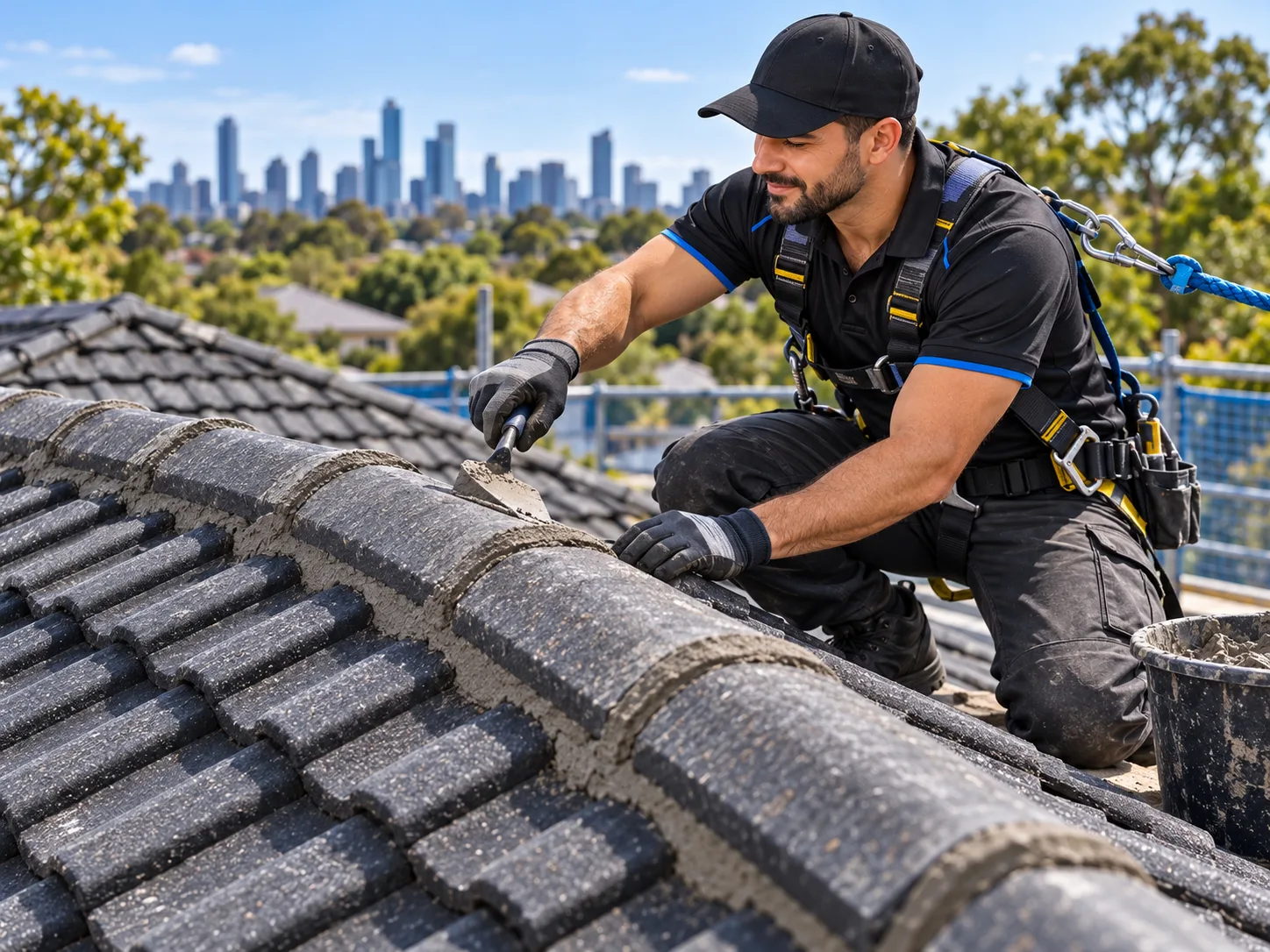
On a Frankston tile roof the usual order is mortar and metal, then valleys, then the tile if moisture and lichen stayed long enough. Foreshore streets, Frankston South ridges, and open elevated lots move through that order faster than a sheltered court. Faster is not the same as finished. If the tile is hard and the sarking is dry, restoration is still the right job and replacement is the waste. If the order has reached the body, restoration is the waste. We will say which, including on a house that “feels coastal” and is not yet done.
Metal on the same fringe fails at washers, flashings, and cut edges before the whole sheet is scrap. Replacing a roof because the screws died is a mismatch when the sheet is still a sheet. Replacing it because the laps have opened and the underlay is finished is the honest scope. Mixed roofs — old tile on the main house, metal on the extension — get one junction designed, not two half jobs. The failed half is replaced. The sound half stays, with coastal-sensible flashings at the join. Stripping both because one side smells of salt is how budgets disappear.
Gutters often die with the roof on this edge, rusting from the outside. They are not automatically included, and they are often the sensible extra while scaffold is up. A quote that hides new gutters, or that leaves holed gutters off a replace, is hard to trust. Tree litter from gums and tea tree blocks valleys year-round. A blocked valley is not a new roof. A blocked valley over dead underlay is a clue that the new roof must include a valley that can actually carry water.
What the replacement scope has to name
Strip and disposal, including whether the old tile is concrete or terracotta and how it leaves a tight Frankston site. New sarking. Battens where they are part of the system. The new covering, tile or metal, chosen for the pitch and the exposure, not for a brochure that ignores the fetch. Flashings specified for salt air, with the metal named. Valleys. Penetrations. What happens to solar. Edge protection and scaffold, because Olivers Hill, ridge lots, and foreshore parking are not a flat court. Optional gutters as a yes or a no. A make-safe if the roof is open to weather before the new covering lands.
Restoration lines do not belong on this page except as the reason they were rejected. “We considered a re-bed and the tile failed the hand test” is a useful sentence. “Full replacement, coastal grade” with no strip, no underlay, and no flashing spec is a slogan. You should be able to see why restore was wrong in the same document that prices the new roof. If that sentence is missing, you may be buying a new roof for a dull colour.
Access and overlay sit beside the materials. Some Frankston streets will not tolerate a surprise colour or a switch from tile to metal without a check. We do not invent a council yes. We put the check before the order. Height and wind change edge protection. A price copied from an inland estate replace will either omit that protection or arrive as a variation when the southerly is the thing the job must survive.
How owners get sold the wrong job
The cheap path is a coat over a finished field, sold as restoration, that fails before the next winter and makes replacement feel like a betrayal. The expensive path is a strip of a sound roof, sold as the only coastal option. Both avoid the inspect. Roof Revival Melbourne can do either product and is paid to choose. If we restore, the beds and the flashings are in writing. If we replace, the reason restore will not hold is in writing. A company that only coats will try to coat. A company that only replaces will try to replace. The roof does not care which truck they prefer.
Insurance and storm claims are a separate path. Hail or a limb through a sound roof can be a repair or a partial replace. Salt over decades is usually maintenance, not a storm. Do not let a slow Frankston failure be written up as if it were one cell, and do not let one cell be used to strip a roof that needed ten tiles. Read when restoration is a waste of money and restore versus replace before you sign either quote.
What to send
Say if tiles are breaking in your hand, if the ceiling has been wet in more than one room, or if a previous coat is already peeling. Storeys, and how exposed the lot feels. Two ground photos and any report. Do not walk the roof to collect samples. We will test units when we are up there, safely. If the answer is still a restore, we will say so and we will not talk you into a new roof to match a neighbour who had soft tiles.
Frankston replacement is the right job when the system is finished. It is the wrong job when the system is tired at the ridges and the metal details. The page that carries the replace is the Frankston replacement scope. The decision still happens on your roof, not in the suburb name.
Choosing replace over restore
- 1. Test the tile or the sheet, not the salt crust
- 2. Check sarking and battens
- 3. Say plainly why a coat will not hold
- 4. Write strip, underlay, flashings, and access
- 5. Keep a sound plane instead of stripping it for company