

Key takeaways
- Most Glen Waverley concrete from the 1970s to the 1990s is a restore candidate until the tile says otherwise.
- Say no when the tile breaks with a dull edge, the noses are gone across a plane, or more than about a fifth of the field is crumbling.
- Inspection first, in writing. Re-bed and repoint of the ridges and hips that have failed, which on a first-cycle Glen Waverley roof is often most of them.
General guidance for Melbourne roofs. The written scope after an assessment decides the work.
The short version
Most Glen Waverley concrete from the 1970s to the 1990s is a restore candidate until the tile says otherwise. The cement unit was dense. The bedding was rigid and has powdered. The colour has chalked on the sun planes and filmed over on the shaded ones. That pairing is exactly what a proper restoration is for: reset the joints, swap what is broken, prepare the face, coat a system specified for concrete. It is not what a wash is for, and it is not what a new roof is for.
The local job page is Glen Waverley roof restoration. Plan a standard home around $4,000–$12,000 for that restore. Plan replacement from about $20,000 when the test fails. High Street Road two-storeys, a single-storey court, and a house with a 2000s upper addition do not share one figure inside the band. The right job is a condition. The price is the condition plus access.
The test that says yes
Knock the tile. Turn a nose that looks thin. A hard unit with a worn colour and a grey heart underneath is a yes. Dry sarking, or sarking wet only in a bay you can explain with one open hip, is a yes. Ridges that have cracked, dropped bedding, or filled the gutter with powder are not a reason to say no. They are the reason the restore exists. A counted list of cracks near trees or along a solar walkway is part of the yes, as an allowance, not as a verdict.
Valleys that need steel, and aprons at an added storey, can sit inside the yes. They are lines. They do not convert a sound field into a replacement. Solar that must come off so the bays underneath are actually done is a line too. Skipping those bays is how a “yes” restore leaks in year four and gets remembered as a failed product. The product was incomplete. The tile was fine.
You can also say yes to the joints and no to a full vanity coat, if the face is acceptable and only the hips have failed. That is a smaller job than a restoration. Roof Revival Melbourne will offer it when it is honest. The right job is the one that matches the failure, even when the suburb’s default story is “full restore.”
The test that says no
Say no when the tile breaks with a dull edge, the noses are gone across a plane, or more than about a fifth of the field is crumbling. Say no when battens have rotted under a long leak, or sarking is damp across bays you cannot tie to one junction. Say no when a previous coating is flaking off tiles that were already soft, and a new film would only glue dust to a finished body. Those are replacement facts. Coating them spends the restore money and leaves you the replacement anyway.
A second or third spray is the local version of this no. Glen Waverley has roofs that were “done” without a bed reset. The colour lasted a couple of summers. The powder came back. Another coat on that stack is not persistence. It is the same mistake with a new invoice. If the tile under the failed film is still hard, the right job is a real restore: film dealt with, beds rebuilt, then a specified system. If the tile under the film has pitted through, the right job is to stop.
The waste test is not an insult to the suburb. It is how we avoid selling the right-looking product onto the wrong substrate. We would rather walk away from a restore in Glen Waverley than attach a workmanship promise to a field that will not hold it.
What the right restore contains
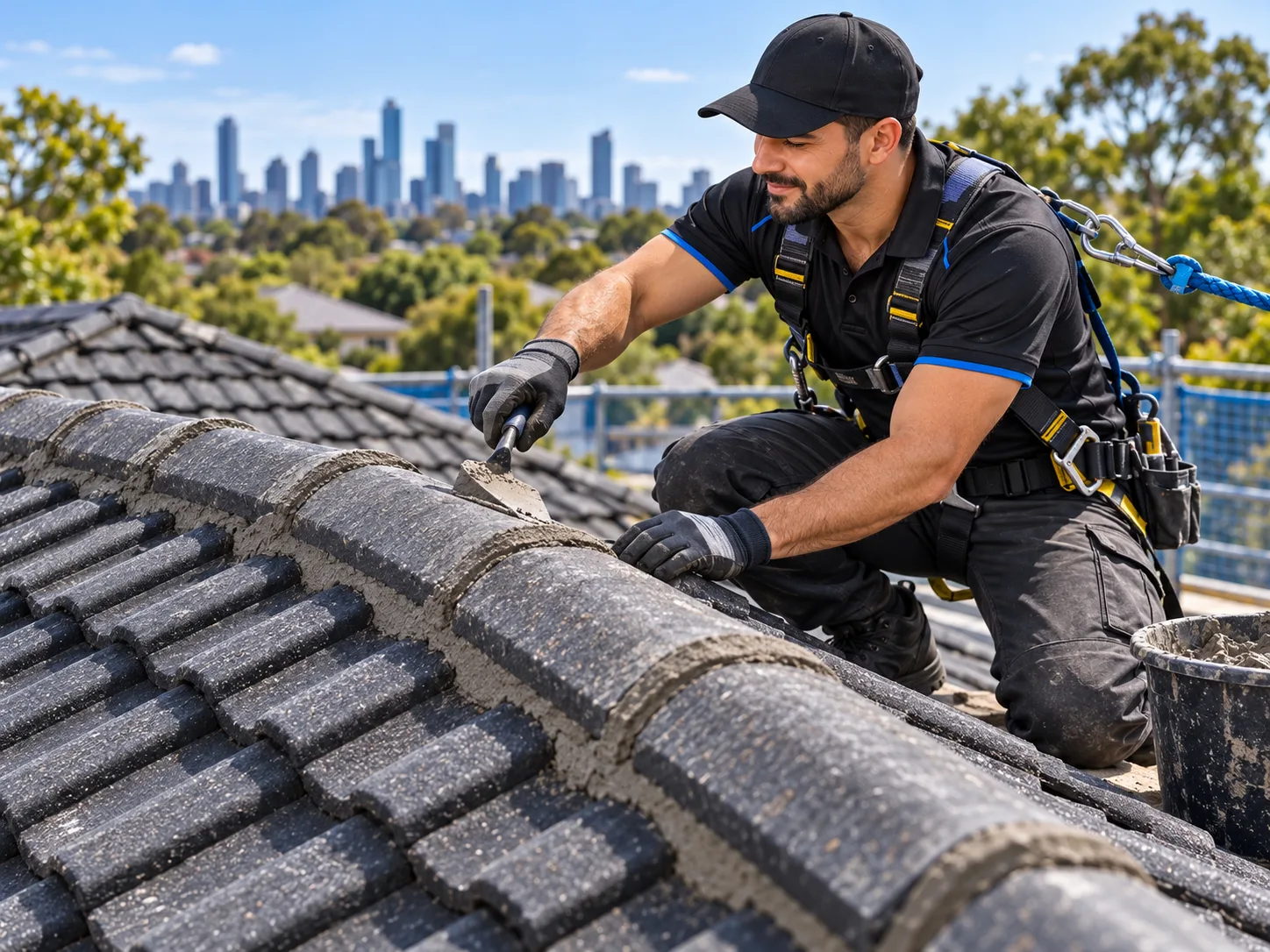
Inspection first, in writing. Re-bed and repoint of the ridges and hips that have failed, which on a first-cycle Glen Waverley roof is often most of them. A tile allowance with a number, not a shrug. Prep that removes chalk, growth and failed film so the new coat touches tile. A coating system named for concrete, not “seal and paint” as a mood. Valleys, flashings and solar called out if they are in. Photos at handover so the joints you paid for are the joints that were done.
What it does not contain is a guarantee that moss never returns under a gum, or that a later hail cell will respect the coating. Maintenance of gutters stays yours. A slipped tile after a future trade walks the roof is a future repair. The restore buys a reset of the waterproofing joints and a protected face on a sound body. It does not buy a new structural roof. If someone is selling it as a new roof, they are selling the other product, and that product starts in the replacement band.
Additions and the half-yes
A common Glen Waverley house is a yes downstairs and a question upstairs. The 1980s concrete has tired beds. The 2006 upper level is younger, harder, and leaking only at the apron where it meets the old plane. Restoring both faces because they share a street address can be right if you want one colour. It can be wrong if the upper tile does not need a system yet. We will restore the original, flash the junction, and leave the upper field when that is the accurate split. A building report that says “replace” across both planes because one stain was visible does not override the split. It is a reason to look.
Colour matching across the two eras matters after the water path is closed. A coat on the old plane only will read as two roofs from the driveway, which you may accept. A coat on both is a choice about appearance once the mechanical work is listed. Do not let the colour choice drag a sound upper roof into a restore it has not earned, and do not let it excuse skipping the lower ridges.
How to decide before you book three coats
Ask each quote: did someone knock a tile, and what did it do? Which ridge metres are re-bedded? What is the broken-tile number? Is there a valley line? What happens to the old coating if there is one? If the answers are “the roof is old, so we coat it,” that is not the right job even if the price sits neatly in the $4,000–$12,000 band. The band is a planning range for a system. A paint job can hide inside it or under it. Read the verbs.
Send Glen Waverley, storeys, whether you added a level, two photos of different planes, and any ceiling stain. Roof Revival Melbourne will say yes to restoration when the concrete can carry it, a smaller repair when only a joint has failed, and replacement when the body has already left. The right job is whichever of those three the tile supports.
Typical inspect-to-scope process
- 1. Test the concrete body in the hand
- 2. Map failed beds against dry or wet sarking
- 3. Separate a full restore from a joint-only repair
- 4. Quote the system, or move to replacement
- 5. Handover photos of beds, swaps and face