

Key takeaways
- Ask what a Rowville roof usually needs and the honest answer is mechanical work on a lid that has not finished.
- Rowville is not Camberwell terracotta and it is not a Ferntree Gully foothill pitch.
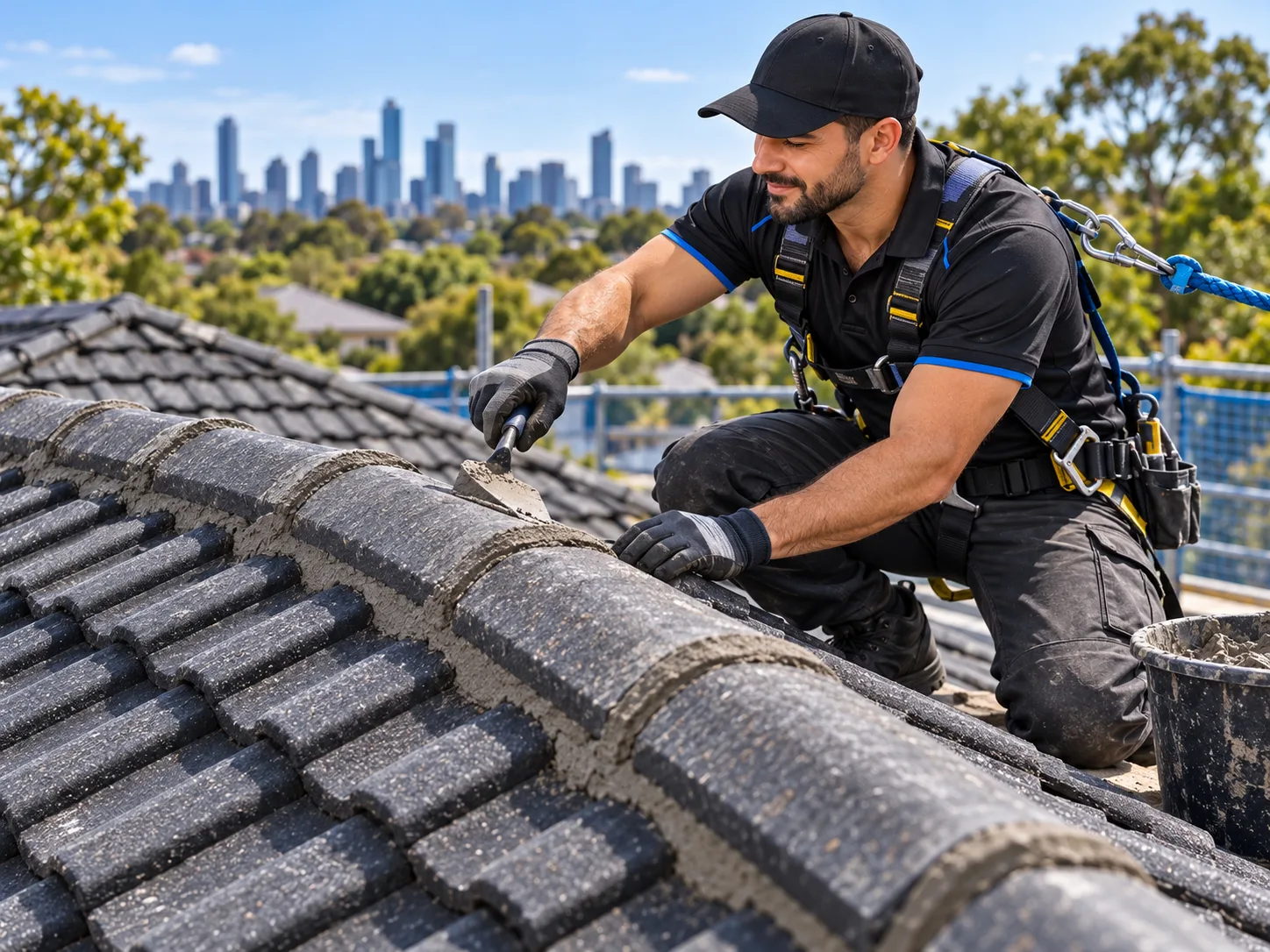
- Ridges and hips come first. Water that enters a powdered bed tracks along the apex and stains a hallway that everyone blames on “the tiles.” The field tiles may still be the wrong suspect.
General guidance for Melbourne roofs. The written scope after an assessment decides the work.
The short version
Ask what a Rowville roof usually needs and the honest answer is mechanical work on a lid that has not finished. Knox estates filled with straightforward hips and gables. Original sand-cement pointing has cooked. A handful of units have cracked near trees, solar walks, or a TV bracket. Valleys hold leaf. The coloured face has chalked. That set is a restoration when the tile still rings hard and the roof space is dry. It is a replacement when the field crumbles or the underlay has been wet for years.
The money page for this job is roof restoration Rowville. Planning bands for a standard home sit around $4,000–$12,000. A re-roof commonly starts around $20,000. Those are Melbourne planning figures, not a Rowville tariff. Stud Road frontages, courts off Wellington Road, and the Lysterfield edge do not share one invoice. Squares, storeys, ridge metres and how much valley steel is left set the quote after someone is on the roof.
What the estate stock actually is
Rowville is not Camberwell terracotta and it is not a Ferntree Gully foothill pitch. The volume is concrete tile on single and split-level brick veneer, laid when the suburb moved from paddocks to courts. Monier and Boral-style profiles in charcoal, terracotta-look and slate grey dominate the streets around Stud Park, the golf course side, and the older blocks closer to Scoresby. Later courts added a second storey or a rumpus pop-up. Some 2010s infill is already Colorbond. This article is about the tile estates, because that is the lid people are being sold a “restore” for from a letterbox card.
Those roofs are on a first genuine maintenance cycle, or just past it. The tile was a dense cement product. The bedding was rigid mortar. Melbourne’s eastern heat opens that mortar. Winter rain sits in the crack. Powder shows in the gutter after a northerly. Owners see a dull roof and assume the tile has died. Often the face has worn and the joint has failed, which is a different sentence from “the roof is finished.”
Near Lysterfield and the park edges the canopy is heavier. Leaf load in valleys is a Rowville fact, not a personality. Closer to the shopping strip the roofs are barer and hotter, so the mortar fails by UV rather than by shade. Both streets can need the same restore method. They do not need the same prep time. A shaded south plane with lichen takes longer to bring back to a coat-ready field than a bare hip that has only chalked.
The usual list, in the order that matters
Ridges and hips come first. Water that enters a powdered bed tracks along the apex and stains a hallway that everyone blames on “the tiles.” The field tiles may still be the wrong suspect. Re-bed and repoint is the repair inside a restore. A coating sprayed over powder pointing is paint. It will open again. Roof Revival Melbourne will not sell the face and leave the joint.
Next is a counted tile allowance. Estate roofs pick up cracks where a branch has dropped, where an installer walked the batten line, or where a tile was already soft at the nose from the day it was laid. Twelve cracked units are a swap list. A plane that crumbles in the hand is not a swap list. The line we use is practical: if more than about a fifth of the field is finished, coating it wastes the preparation. That conversation belongs with signs you need a new roof, decided on the roof, not from a driveway photo.
Valleys, apron flashings at an added storey, and pipe penetrations are the third group. A 2000s extension dumped a new valley onto a 1988 plane. The leak lives at that junction while the main field only looks tired. Whirlybirds and solar conduits that were never dressed become winter drips. Gutters that have silted and lost fall overflow into the eaves and get written up as roof leaks. We list those lines. We do not strip a sound lid because a trough overflowed.
What the inspect is allowed to say
We walk the roof and, where it is safe, the roof space. We knock tiles. We look at sarking for wet tracks, not for a stain that could be a decade old and dry. We measure the ridge and hip that actually need bedding, not a guess from the street. We photograph broken units, open beds, and valley steel. The written result is restore, a shorter repair, or replace. Rowville’s default is restore. The default is not a promise. A court house with soft noses and damp underlay leaves the default behind.
Solar is common on these estates and has to be in the scope. Panels that stay on while the bays under them are skipped become the leak in year four. If the array has to come off and go back, that is a line, not a surprise on day two. We also say when the only real defect is leaf in a sound valley and tight mortar. That is not this article’s job. Prep washing sits inside a restore. A wash sold on its own does not reset a bed.
Colour is the last decision, not the first. A light face on a hard tile changes how hot the roof space runs. It does not fix a hip. If a previous spray is already peeling, the new system has to deal with that film. A second colour over a failed first colour is how these estates collect roofs that look fresh from Wellington Road and flake on the western plane. We will say when the old film makes the job larger.
When the estate roof should not be restored
Restoration is the wrong product when the tile body has ended. Crumbling edges, tiles that snap across a bay, battens that have rotted under a long leak, and sarking that is wet in more than a local patch are replacement facts. A coating warranty does not cover a finished substrate. Roof Revival Melbourne would rather lose the restore than attach one to a soft field. Replacement from about $20,000 is the planning start for a typical home, then access, pitch and material move it. We do not invent a Rowville special.
A short repair is also the right product sometimes. One open hip, a cracked apron at the chimney, or a dozen tiles after a limb drop can sit under a full restore and still be the honest spend. We write that scope if the rest of the lid is tight. Selling a full coat because the street is “due” is how owners pay twice. The test is the roof in front of us, compared with the failure pattern this suburb usually shows, not a package price from a flyer.
What changes the quote without changing the suburb
Single-storey hips with a clear side access are the simpler Rowville week. Two-storey fronts, steep driveways, and pools hard against the eaves add height and protection. A second-storey addition adds flashings the original gable never had. Tree cover near the lake park adds valley hours. None of that is a travel surcharge invented after you mention the postcode. It is time and method, written down.
Bring the building report if you are mid-sale. Inspectors often write “replace” because they saw cracked pointing from the manhole. That sentence may be true about the joint and false about the tile. We still inspect. Photos of the palest plane, the darkest plane, and a hip from the ground are enough to book the visit. The quote follows the visit.
Typical inspect-to-scope process
- 1. Walk the roof and the roof space
- 2. Test the concrete body and the bedding
- 3. Count tiles, valleys and flashings as separate lines
- 4. Quote a restore, a shorter repair, or a replacement
- 5. Handover photos of the joints and the face