

Key takeaways
- Narre Warren filled with family estates through the 1990s: repeated hip plans, concrete tile, brick veneer, one and two storeys.
- The plans repeat. A hip or a simple gable, concrete units in charcoal or terracotta-look, ridges bedded in mortar that has now cooked through thirty summers and opened through thirty winters.
- First, every ridge and hip, not the one visible from the driveway.
General guidance for Melbourne roofs. The written scope after an assessment decides the work.
The short version
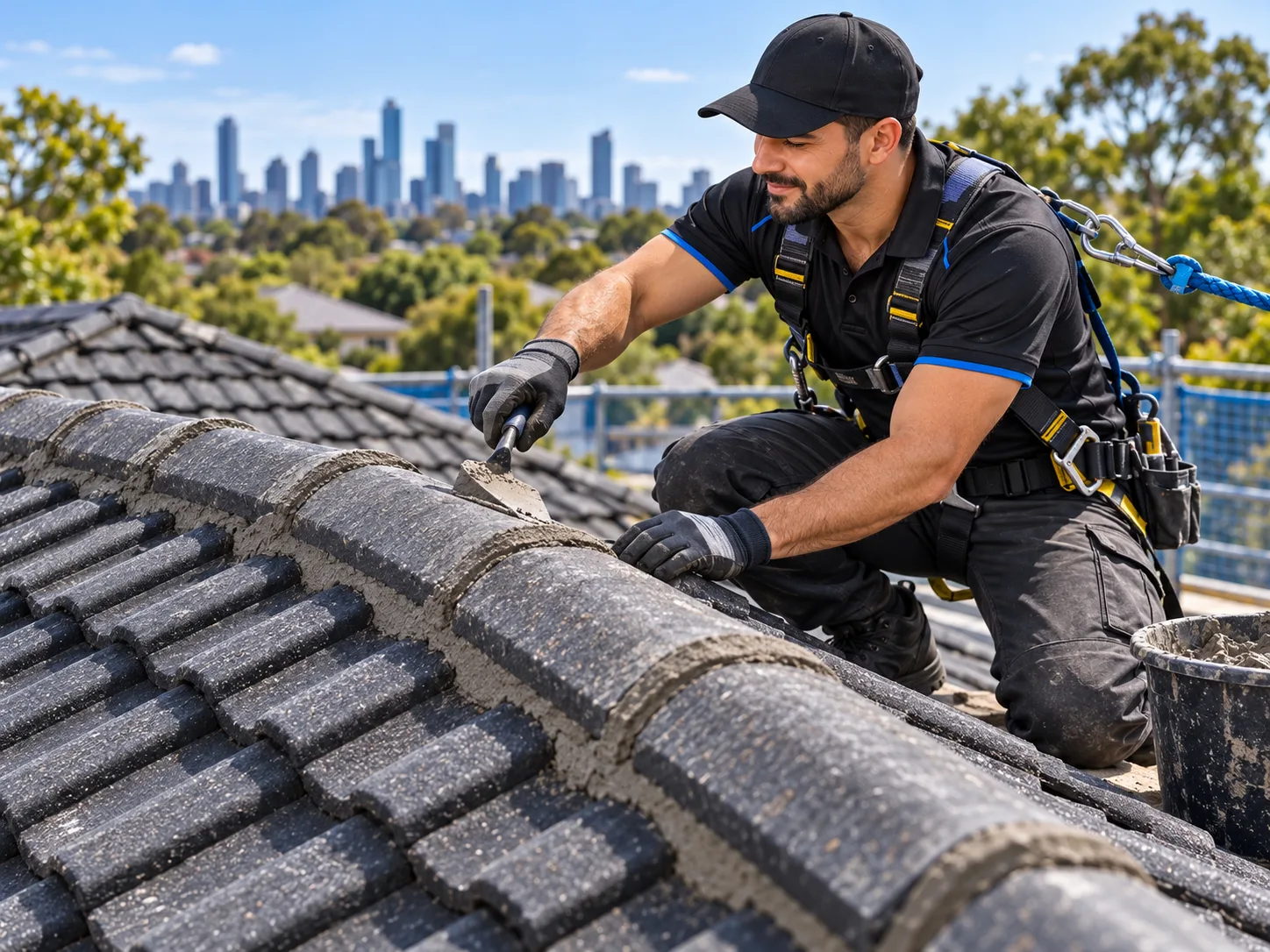
Narre Warren filled with family estates through the 1990s: repeated hip plans, concrete tile, brick veneer, one and two storeys. Those roofs are now on their first serious maintenance cycle. The tile is often still dense. The original mortar is often powder. That is the usual need, and it is a restore, not a strip. Roof Revival Melbourne still walks each lid, because a court full of similar houses is not a court full of identical failures.
The Narre Warren job sits on roof restoration Narre Warren. The notes name the estate and the storeys. A standard home often plans inside $4,000–$12,000. That band is how you recognise a spray that skipped the beds. It is not a Narre Warren price list. North and South are quoted as their own access, not as one day rate plus a guess.
What these estates usually are
The plans repeat. A hip or a simple gable, concrete units in charcoal or terracotta-look, ridges bedded in mortar that has now cooked through thirty summers and opened through thirty winters. From the footpath the roof looks dull. In the gutter there is powder. In the ceiling there may be a stain that tracks from the ridge, which everyone calls “the tiles” when the field tiles are still the wrong suspect. Re-bed and repoint is the usual repair. A colour change without that reset is how the estate pays twice.
Broken units are usually a handful, not a field. Tree lines, a cracked unit under a whirlybird, a few along the path a solar installer walked. Those sit inside a restore as an allowance. They are not a reason to tell a whole court it needs Colorbond. If we lift tiles and they snap, or the plane is already a patchwork of soft replacements, the usual story stops and replacement starts. The usual story is a hypothesis. The tile in the hand is the test.
This is not a coastal salt article. Narre Warren does not get Frankston’s bay air as the main character. It gets south-east heat, winter wet, and leaf. Moss on a shaded court behind a fence is common and is growth, not rot. Lichen follows. Prep has to remove it before a coat, or the coat fails and the estate concludes that “restoration does not work”. Restoration without prep was never the product.
What 1990s roofs usually need done
First, every ridge and hip, not the one visible from the driveway. The bed is the waterproofing. Pointing over a dead bed is makeup. Second, a written allowance for broken tiles and for tiles we break doing the work properly. Third, valleys. Estate blocks grew trees. Valleys hold the leaf, then the iron rusts. A holed valley is a line in the same week as the ridges. Fourth, penetrations: vents, pipes, and solar mounts that were screwed through and never flashed as if water were real. Fifth, prep of the face, then a coating specified for concrete, not a hardware-store colour.
Gutters are the maybe. Many 1990s troughs have never been reset and now sit low, so water runs back into the fascia in a downpour. If they are holed, replace them while access is up. If they are only dirty, say so. A restore quote that quietly assumes new gutters, or quietly omits holed ones, is hard to compare. Sarking is the other maybe. Dry underlay means the restore is protecting a roof that still has life. Wet underlay across bays means the usual estate job is the wrong job, and we will say that even if the neighbour’s identical plan was a straightforward restore.
Two-storey houses in the same estate are not a surcharge you discover on day two. Height goes in the quote. Narrow side setbacks on the tighter blocks change scaffold. We look at that on the inspect. A price copied from the single-storey display home will either skip the high hips or send a variation. You should see storeys on the page before you sign.
What they usually do not need
They usually do not need a full replacement because the colour is tired. They usually do not need a “heritage” method. They usually do not need a marine fastener spec. They usually do not need every tile swapped because a building report saw moss and wrote “replace” from the ground. Bring the report if you have one. We still test the body. A report is a list of observations. It is not an invoice, and it is not a reason to strip a hard tile field that needs beds and prep.
They also do not all need the full restore this year. A roof whose mortar is still tight and whose only issue is leaf in the trough is maintenance, and we will say if you have booked the wrong product. Selling a coat to a sound young ridge wastes the band. The 1990s stock is “usually” ready. Usually is not always. Narre Warren South’s later streets are younger than the first courts. Age is a clue. We do not invoice the clue.
Extensions are the exception that looks like the rule. A 2000s upper storey on a 1990s tile leaves a junction: apron, soaker, a valley onto the old plane. The leak lives there while both fields look fine. The usual estate scope has to grow a junction line, or the restore “fails” in the only place the water was ever going to enter. We treat original and addition as one system.
How to read a quote for this stock
Look for ridge metres, a tile number, valleys, prep, and the coating name. Look for what is excluded. If two quotes differ by thousands, the gap is usually the beds or the storeys, not a mystery Narre Warren tax. The Melbourne planning band of about $4,000–$12,000 is a sense check for a standard single-family restore. Large two-storey hips move up. A single ridge repair can sit under the band and be correct. Replacement, if the field is finished, commonly starts around $20,000 and should not be compared with a spray as if they were options on the same menu.
Roof Revival Melbourne will not sell the third coat on a roof whose first “restore” left the mortar in place. If a previous film is peeling and the tile is still hard, the remedy is to do the mechanical work and prep properly, not to tint the peel. If the tile is finished under that film, we replace. Read ridge capping mortar failure for the bed itself, and a second restoration on the same roof before you pay to repeat a shortcut.
What helps the inspect
Say the decade the house was built if you know it, one storey or two, and whether there is a stain or only a dull face. Two ground photos of the ridge and one of any ceiling mark are enough to book a time. They are not a diagnosis. We need the roof and, where it is safe, the roof space. Do not walk the tiles to “check for us”. Concrete looks tougher than it is, and a foot through a unit is a worse start than a distant photo.
The usual 1990s Narre Warren roof needs its ridges rebuilt, its broken units swapped, and its face prepped before any colour. That is a restore. Anything louder — a new roof because the court looks old, or a wash because the moss is the only thing you can see — is a different product, and we will name it.
Usual estate scope
- 1. Test the concrete body, do not trust the colour
- 2. Measure ridges and hips, including the hidden ones
- 3. Count cracks, valleys, and penetrations
- 4. Check sarking and storeys
- 5. Quote the system, or say it is not due