Key takeaways
- Ringwood and the streets around it carry a lot of concrete tile under real canopy.
- Gums and other large trees drop leaf into valleys and keep winter sun off one or two planes.
- The concrete or terracotta body has to be sound. Ringwood’s volume is the same eastern concrete generation you see in the middle east, often a little more shaded.
General guidance for Melbourne roofs. The written scope after an assessment decides the work.

The short version
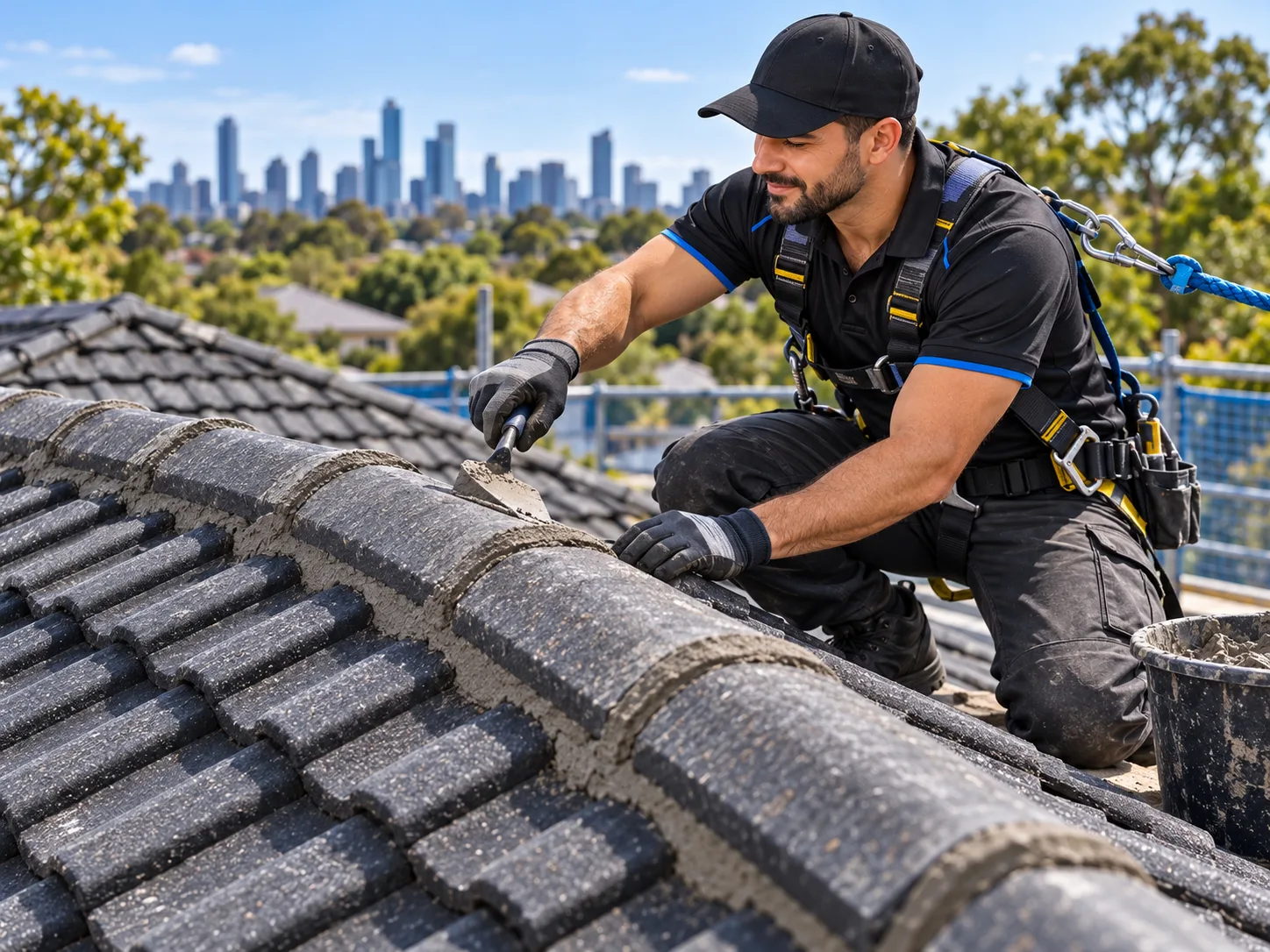
Ringwood and the streets around it carry a lot of concrete tile under real canopy. South planes go dark. Gutters fill. Owners are told the roof “needs a restore” because it looks biological. Sometimes the beds have failed and a restore is exactly right. Sometimes the tile and the mortar are fine and the trough needs clearing. Moss cannot tell those apart. It only tells you the plane stays damp. The decision is still the tile in the hand and the joint under the cap.
That decision is what Ringwood roof restoration is for when the answer is yes. A standard home is often planned around $4,000–$12,000. Replacement commonly starts around $20,000 when the body has finished under the growth, not because the growth is there. Tree hours change prep. They do not create a Ringwood moss product with its own price.
What the trees actually change
Gums and other large trees drop leaf into valleys and keep winter sun off one or two planes. The leaf holds water against valley steel until the steel rusts. The shade grows moss and lichen on the tile nose. A limb in a storm cracks a bay of units and can bruise a batten. Those are three different lines on a restore: valley repair, prep time, and a tile allowance. None of them is “spray the moss and call it sealed.”
A coating over live growth and a packed valley looks even for a season and then stains at the internal corner, while the ridge you did not re-bed keeps leaking. Prep is inside the restore because of this, not as a courtesy wash. If we are not restoring — because the joints are tight and you only disliked the colour of the shade — we will say the coating is optional or unnecessary. Clearing a valley so it can drain can be a repair on its own. It should be named that way.
After a restore, trees do not retire. Leaf returns. That is maintenance of gutters and valleys, not a defect in the bedding. We will not write a scope that pretends a Maroondah canopy becomes a bare court. We will write one that does not confuse the next autumn with a failed coating.
What still has to be true for a restore
The concrete or terracotta body has to be sound. Ringwood’s volume is the same eastern concrete generation you see in the middle east, often a little more shaded. Hard tile, tired mortar, chalk where the sun still hits: that is a restore. Soft noses hidden under moss are not a restore discovered late. We lift units on the dark plane on purpose, because the green is where people stop looking. A tile can be ugly and hard, or ugly and finished. The moss is camouflage for both.
Ridges still come first. Shade does not preserve mortar. Hot roof spaces on the bare planes cook it, and the damp planes keep the cracks wet. Powder in the gutter after wind is the same clue as in Box Hill. Re-bed and repoint is the waterproofing. The biological film is the surface you must not coat until it is gone. Order matters. Companies that lead with the film are selling what the customer can see from the nature strip.
Sarking tells you whether the trees have been leaking for years or whether you are looking at a dirty sound roof. Wet tracks under a valley are a valley finding. A dry space under a black south plane is a prep finding. We photograph both so the scope cannot collapse them into “tree damage.”
Limbs, solar, and the crack list
A fallen branch is not a mood. It is a count of broken tiles and a look at what they were nailed or clipped to. Replace the broken allowance inside the restore if the surrounding field is hard. If the strike opened the roof space to weeks of rain, the timber in that bay is part of the note. It still may not be a new roof. It is not “moss” either. Call the storm what it did.
Solar on a treed roof is awkward. Panels shade the tiles further, and leaf packs at the frame. If the array stays down during the restore, the bays under it get missed and become the leak later. Sequence the panels. If droppings and leaf are the only issue under a tight roof, do not restore the house to reach one corner. Say which corner.
When the trees have been blamed for a finished tile
Years of moisture at the nose can fret a tile that was already soft. If we find crumbling under the film, the restore stops. Replacement from about $20,000 is the planning start, then access and how much of the canopy complicates the strip. Blaming the gum is optional. The specification is the unit. Roof Revival Melbourne will not coat a finished field because the suburb is known for trees and the quote needs a story.
The other wrong story is that every Ringwood roof is due because the neighbour’s was green and then grey. The neighbour may have bought paint over powder. Read their scope before you copy their colour. Our cleaning before coating note is the prep principle. It is not a DIY recipe, and it is not permission to stop at the clean.
Timing with the canopy
If you are about to remove or heavily prune a tree that sits in the valley, tell us before we clear and coat. Fresh pruning fills a valley that was part of the handover. We are not arborists and this page is not a cutting guide. It is the overlap between two trades. A restore done in the week before a planned limb drop is a sequencing mistake you can avoid with one sentence on the form.
Send Ringwood, storeys, a photo of the darkest plane and a photo that shows the trees against the roof. Mention any limb strike and any ceiling stain. Roof Revival Melbourne will write ridges, tiles and valleys if they have failed, and we will leave moss in the notes where it belongs. The green is not the scope.
Typical inspect-to-scope process
- 1. Lift tiles under the growth, not only in the sun
- 2. Separate moss, leaf, limb cracks and ridge failure
- 3. Scope valleys and beds as the waterproofing
- 4. Quote a restore only if the body can take it
- 5. Handover photos of joints and cleared valleys