

Key takeaways
- On the phone we can hear suburb, storeys, tile or metal, and a rough size.
- Quote day decides whether the gutters stay. Tile drip edges and metal drip edges are not the same relationship.
- Two quotes both labelled Colorbond can leave quote day as different products.
General guidance for Melbourne roofs. The written scope after an assessment decides the work.
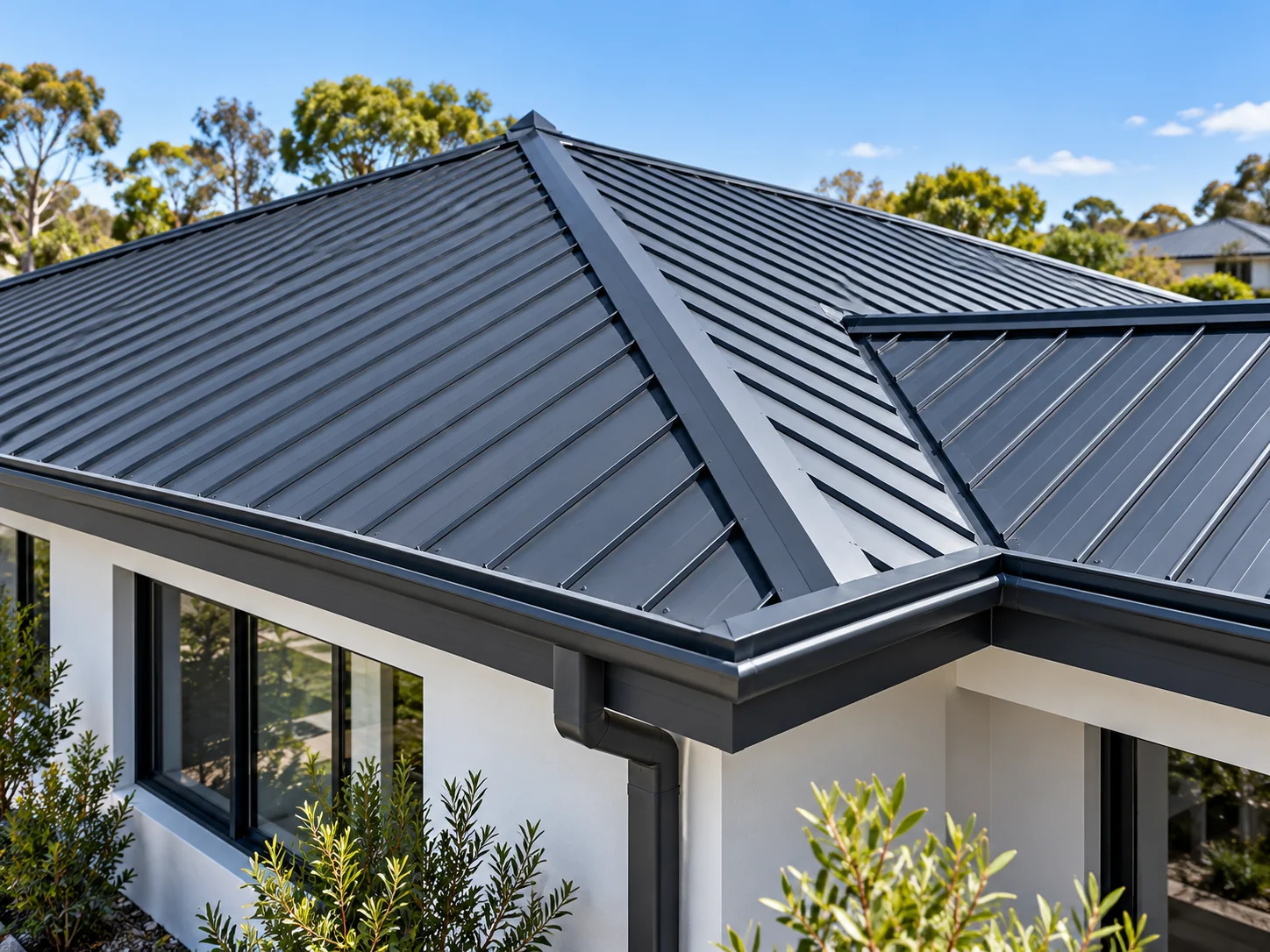
The phone can hold a band, not a roof
On the phone we can hear suburb, storeys, tile or metal, and a rough size. That is enough to say a standard replacement commonly starts around $20,000, and that two storeys, steep hips or a solar array will move it. It is not enough to name the profile, the flashing list or the fascia. Quote day is when someone stands on the roof and the number becomes a scope. If a price arrived by text before that visit, it is a guess wearing a dollar sign. The job itself is Colorbond roof replacement in Melbourne.
Quote day can also cancel the replacement. A hard concrete tile roof with tired ridges is often a restore, and a standard home often sits around $4,000–$12,000 for that work. We will write the restore beside the replacement when both are real. Households who wanted steel for the look can still choose it, where the street allows, and they will see the gap. Households who wanted the leak to stop can choose the smaller honest job. The phone rarely hears that distinction. The roof shows it.
What the tape measure changes
Squares change. Owners remember the floor plan. Roofs remember eaves, verandahs, a rear skillion and a garage that was “not really the house”. Pitch changes the sheet layout and the safety setup. A low rear addition that looked steep from the garden can be too flat for the profile everyone assumed. Valleys and split levels add flashing and waste. We measure. The quote that follows should show area and a note on pitch, so a second company can be compared on the same roof rather than on two different imaginations.
Access changes the day rate before the steel price does. A two-storey Doncaster roof over a pool, a steep drive in the east, no place to land a skip, a laneway terrace with a footpath: quote day records how the old roof comes off and how the new sheet goes up. A phone quote that assumed a wide side yard will be rewritten on the footpath. We would rather rewrite it there than absorb it as unpaid hours and a rushed hip. Scaffold, when it is required, is a line. “Access included” with no look is a hope.
Gutters, solar and the lines people forget
Quote day decides whether the gutters stay. Tile drip edges and metal drip edges are not the same relationship. Rust, fall and outlets are visible from the ladder in a way they are not from a kitchen phone. Fascia rot is the same. If the timber cannot hold a new gutter, the carpenter’s work joins the scope or the quote says it is by others, in words. Silent fascia is how the installation stops at lunchtime.
Solar is the other rewrite. Panels have to come off, the roof has to be finished, and the panels have to go back on fixings the new sheet can accept. Quote day asks who isolates and who reinstalls. A replacement that says “roof only” can be fair if you already have that trade booked. It is a change from the phone picture of “a new roof next week, panels untouched”. Skylights, flues and evaporative units get the same treatment: each flashing is either in the price or named as out. Colour lead times change the start date, not usually the engineering, but a covenant colour or an overlay can change whether we order at all.
Profile, specification and the old roof underneath
Two quotes both labelled Colorbond can leave quote day as different products. Corrugated and concealed-fix do not share a batten layout. Sarking and insulation are either specified or they are missing. We write what we are ordering. We also write what we found under the old roof: battens that will be replaced, sarking that is gone, a frame that needs work. If we could not see the roof space, the quote says so and carries an allowance or a condition. Inventing a dry frame from the kitchen ceiling is how variations are born.
Asbestos suspicion changes the program. Some eaves, garages and older sheeting need a licensed removalist before a casual strip. Quote day identifies that limit. It does not include a homeowner removal method, and it does not fold cutting that sheet into “take off the old roof”. The start date moves until that trade has done its job. Pretending quote day did not see the sheet is how the wrong people get asked to handle it on the morning of the strip.
What you should leave with
A scope you can read without us in the room: profile, colour proposal, area, pitch note, sarking, flashings, gutters in or out, solar sequence, access, and the reason this is a replacement. Photos of the details that moved the price. A note on anything we refused to include. If an overlay applies, a pause instead of a delivery date. Roof Revival Melbourne would rather you compare that paper with another honest paper than with a one-line text.
Bring to quote day whatever the phone did not have: a building report, a covenant colour, the age of the solar, a leak you can point at. Two ground photos sent earlier help us arrive with the right ladder plan. They do not close the quote. The changes that matter happen when we are on the roof. Sign the document that survived that visit. The phone number you first heard was only the door into it.
Typical quote-day checks
- 1. Measure area, pitch and the real eaves
- 2. Decide gutters, fascia, solar and penetrations
- 3. Name profile, colour and sarking
- 4. Test whether a restore still beats a strip
- 5. Issue a scope that matches the photos