

Key takeaways
- Older Keysborough is often concrete tile on houses that are ready for a first proper ridge cycle: powder beds, a few cracks, a dull face, dry timber if nobody has ignored a leak.
- The earlier concrete hips fail where 1980s and 1990s mortar always fails in Melbourne’s south-east.
- Later Keysborough housing is a different clock. Tile that is ten or fifteen years old may have a builder flashing that was short, a ridge that was bedded thin, or a valley full of construction debris and leaf.
General guidance for Melbourne roofs. The written scope after an assessment decides the work.
The short version
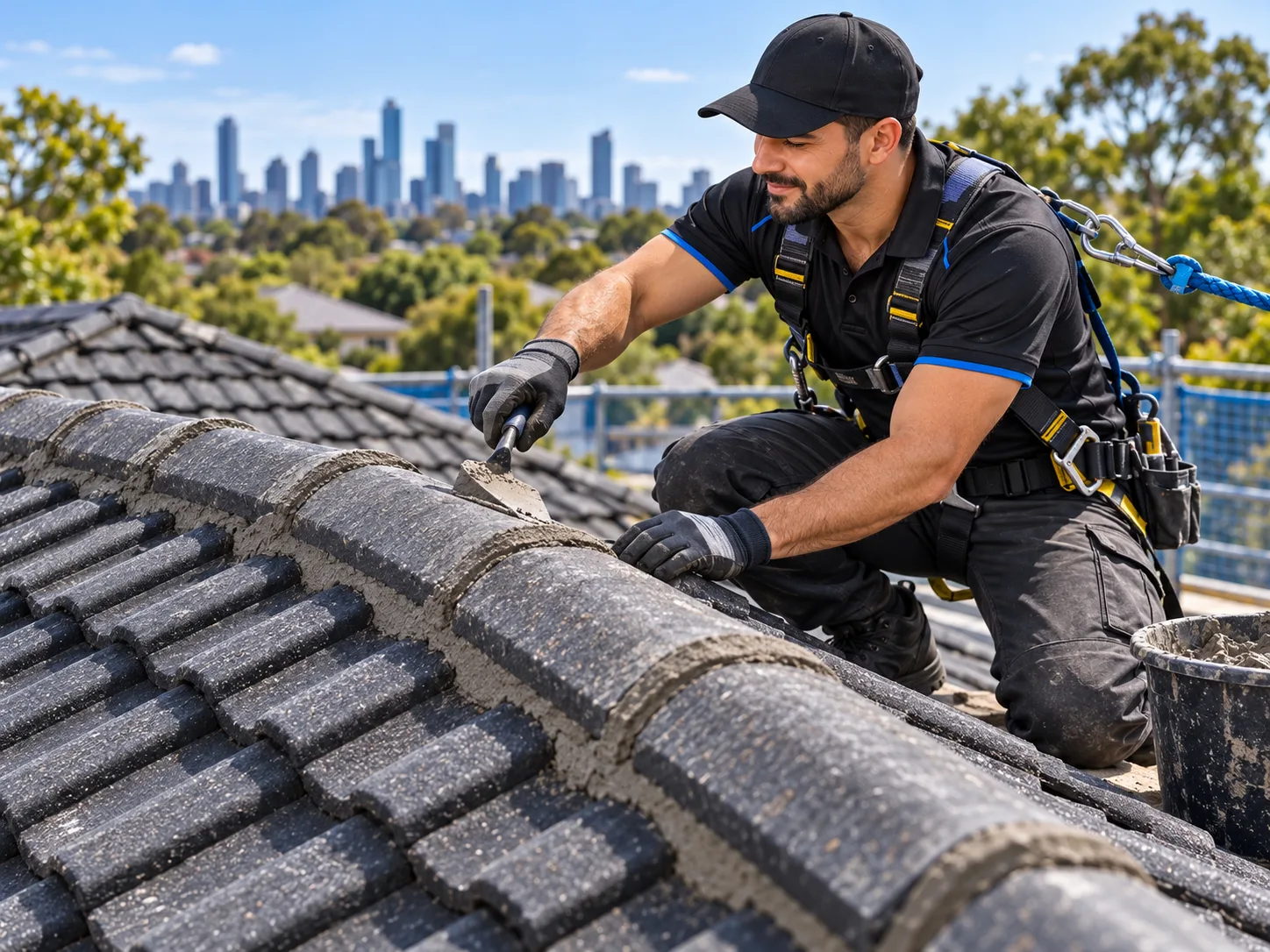
Older Keysborough is often concrete tile on houses that are ready for a first proper ridge cycle: powder beds, a few cracks, a dull face, dry timber if nobody has ignored a leak. Newer estates, including the later pockets towards the south of the suburb, can be younger tile or Colorbond that is not “due” for a restoration just because the older street is. Roof Revival Melbourne will not write one Keysborough recipe. The inspect says which generation is on that roof.
The Keysborough job sits on roof restoration Keysborough. Tell us the decade if you know it. A standard older-home restore often plans around $4,000–$12,000. A newer roof that only needs a flashing is not pushed up into that band to match a neighbour. We quote the lid, not the suburb average.
Older tiles
The earlier concrete hips fail where 1980s and 1990s mortar always fails in Melbourne’s south-east. Heat cooks the bed. Winter opens it. Powder appears in the gutter. The units themselves are often still dense, which is why a restore is the default hypothesis and a replacement brochure is premature. We still lift tiles. A house that looks like its neighbour can have been re-roofed, patched with soft seconds, or coated badly five years ago. The street does not certify the body.
What that older roof usually needs is the full mechanical list: all ridges and hips re-bedded and repointed, a broken-tile allowance, valleys that have rusted under leaf, penetrations resealed, prep, then a coating named for concrete. What it does not need is a wash sold as a restore, or a colour chosen before the beds are on the page. Dust and traffic film from a busier road settle on these faces. Prep has to deal with that film or the coat lets go and the older tile gets blamed for a dirty application.
Extensions on older blocks add the junction problem. A second storey or a rumpus-room pop-up from a later decade meets the original tile at an apron or a valley. The leak is the join. Coating the original plane and ignoring the join is how a Keysborough restore “does nothing” for the room that was actually wet. We scope original and addition together, and we say if the newer plane is fine and only the old ridges are due.
Newer estates
Later Keysborough housing is a different clock. Tile that is ten or fifteen years old may have a builder flashing that was short, a ridge that was bedded thin, or a valley full of construction debris and leaf. That can be a local repair. It is not automatically a full restoration with a new colour. Selling the older-street package to a young roof spends money on a face that has not earned it and leaves the one bad flashing as a maybe. We would rather invoice the flashing.
Some of those newer roofs are metal. Colorbond on a recent house is fasteners, laps, and flashings, inspected for a fault, not coated because the concrete neighbour is being restored this month. If the sheet is sound, say so. If a leak is one boot or one apron, that is a repair. If the sheet has failed, the language is replacement, and the planning figure is a different band, commonly from about $20,000 once the roof is measured. Do not let a tile-restore quote and a metal-replace quote sit in one “Keysborough roof” number.
Newer estate streets are tighter. Two storeys, small setbacks, and lanes change scaffold and delivery. A price lifted from a wide older block will not survive contact with a narrow court. Access goes on the page at the inspect. Solar is more common on the new stock and has to be sequenced if any coat or repair runs under the array. Skipping those bays is how year-four leaks start under a roof that looked finished from the footpath.
How to tell which roof you have
You often know. If the house was there before the later estates, assume older concrete until we test it. If you bought a newer build, do not accept a full restore script from a letterbox drop aimed at 1990s mortar. Photos of the ridge from the ground help us see generation: thick tired beds versus newer pointing, concrete profile versus a metal rib. Age of the house and age of the roof can differ if someone has already replaced the lid. Say so if you know a re-roof happened. We will still check, because “replaced ten years ago” sometimes means “coated ten years ago”.
A building report that says the roof is old is not a scope. Ask which plane, which defect, and whether anyone entered the roof space. Older Keysborough tiles get condemned for moss. Moss is shade and time. Soft tile is the condemnable thing. Bring the PDF. We will not argue with a photo of a real crack, and we will not strip a roof because a clause was copied from a template.
Greater Dandenong’s industrial dust can reach some Keysborough edges and barely touch others. If your face is gritty, prep changes. It does not turn a sound newer roof into a restore, and it does not turn an older hard tile into a write-off. The generation decides the product. The dirt decides the prep. Read when a wash will not save the roof and painting versus full restoration so a colour quote cannot disguise which generation you bought.
One suburb, two scopes
If you are comparing quotes, make sure they are for the same generation. An older-tile restore with ridge metres and a tile allowance is comparable to another restore. It is not comparable to a wash, and it is not comparable to a new-estate repair that only lists one flashing. The Melbourne house band of about $4,000–$12,000 applies to the standard older restore after inspection. It is not a target we drag a small repair up to, and it is not a ceiling on a two-storey older hip that has more ridge than the band assumed.
Roof Revival Melbourne will restore older Keysborough tile when the body is sound, repair a newer roof when only a detail has failed, and say replace when either generation is actually finished. Tell us which house you think you have. We will tell you what the roof says.
Sorting the two generations
- 1. Ask the decade of the house and of the roof
- 2. Test older concrete before any coat
- 3. Keep newer tile and metal on their own scope
- 4. Price access and solar for the street you are on
- 5. Do not average the suburb into one price