

Key takeaways
- Restore and replace are both honest jobs. They are honest on different roofs.
- On tile, the proof is the body. A concrete unit from an eastern brick veneer can chalk, lose its colour and shed its ridge mortar while the biscuit inside stays hard.
- The covering can be sound and the roof still be finished underneath, or the covering can look tired and the space can be dry.
General guidance for Melbourne roofs. The written scope after an assessment decides the work.
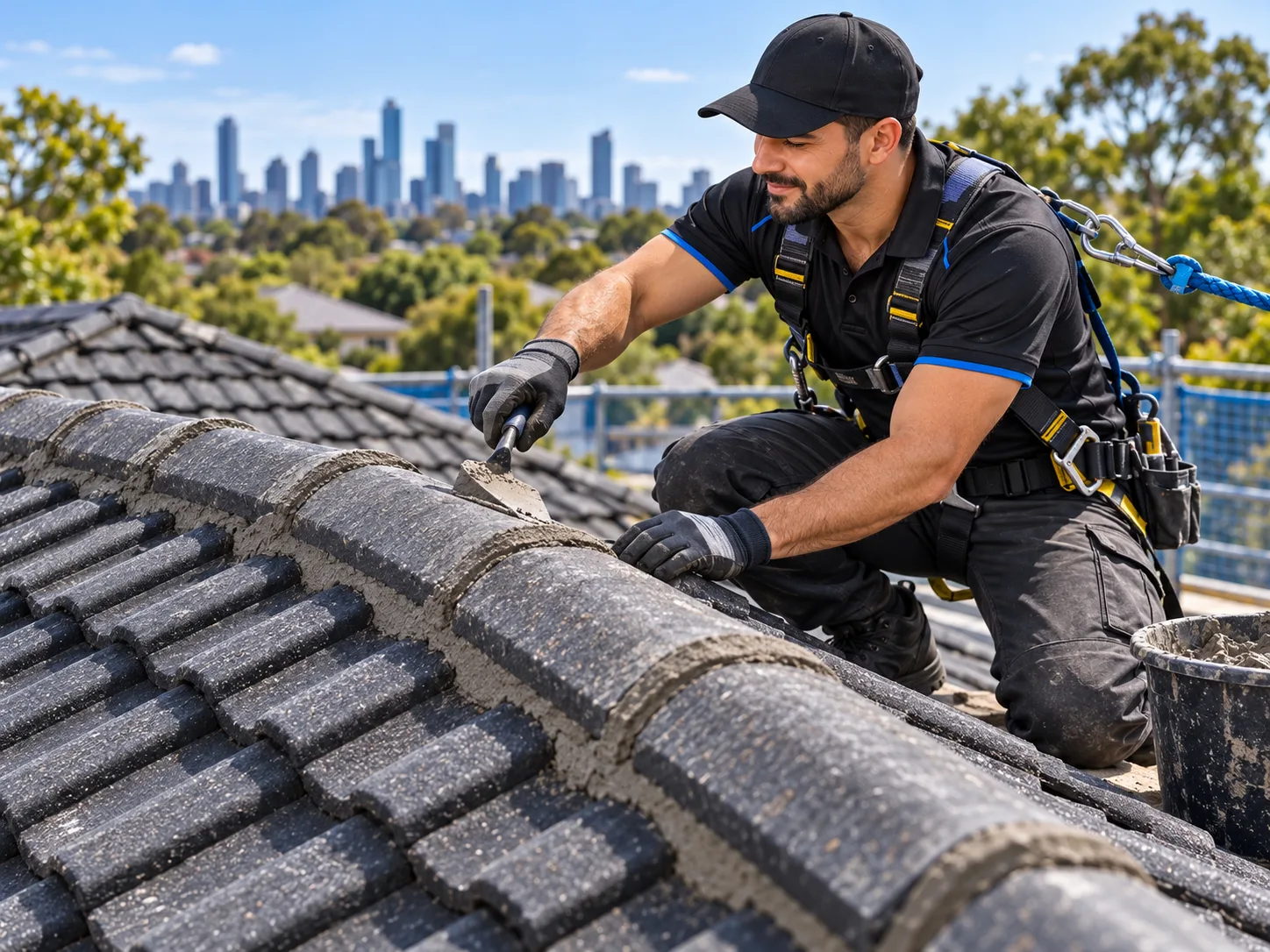
The inspection is a proof, not a pitch
Restore and replace are both honest jobs. They are honest on different roofs. The inspection exists to prove which roof you have, with something you can look at, before anyone attaches a product to it. A company that only sells restoration will try to coat a finished field. A company that only sells replacement will try to strip a hard tile because the replacement is the work they came to do. Roof Revival Melbourne can do either. The inspection is allowed to choose. If it cannot prove the choice, it is not finished, and neither is the quote.
When the proof says the covering is finished, the job is roof replacement in Melbourne. When the proof says the body is sound and the system around it has tired, the honest product is a restore, and we should say that even if a new roof would have been a larger invoice. Planning bands help you recognise the scale. A standard tile restore is often planned at $4,000–$12,000. Replacement commonly starts around $20,000. A steep, two-storey, or awkward roof moves either number. The bands are not the proof. Photos of the tile, the sheet and the timber are the proof.
What the covering has to show
On tile, the proof is the body. A concrete unit from an eastern brick veneer can chalk, lose its colour and shed its ridge mortar while the biscuit inside stays hard. That tile can be restored. A unit that crumbles in the hand, snaps across the lap as a habit, or has lost its nose so water runs back, is finished. A handful of hail cracks on an otherwise hard field is a repair or a restore with a tile allowance. A field where you cannot walk without breaking more is a replacement. We use about 20 percent of a failing field as the point where the conversation changes. It is a threshold we have to show you, not a slogan. If the broken units are clustered on one pitch and the rest are sound, the percentage of the whole roof can mislead. We say where they are.
Terracotta asks for the same proof with a different surface. Glaze can craze and the colour can vary without the clay being done. Bedding can be dust while the tiles are still the ones the street should keep. Soft clay, delaminating units, and a profile you can no longer buy for the number of breaks you are holding are replacement evidence. Matching is a restore problem only while the parent tiles are worth matching. We do not coat a crumbling terracotta field so the street looks tidy for a season.
On metal, the proof is the sheet, the fixings and the edges. Fade on Colorbond is not failure. Rust at cut edges, holed pans, tired screws and laps that have opened are failure. A sound sheet with a tired flashing can be repaired. A roof that oils, dents and still holds water is not automatically a replacement. A roof with rust you can put a finger through is not a repaint. We photograph the place the steel has actually given up, because a wide shot of a grey roof proves colour and almost nothing else.
What the roof space has to show
The covering can be sound and the roof still be finished underneath, or the covering can look tired and the space can be dry. We get into the roof space where there is a safe way in. Sarking that is intact and dry supports a restore or a repair. Sarking that is wet in one bay supports fixing the path that wet it. Sarking that has perished, split and disappeared across most of the roof is part of a replacement case, because a coating on the tiles will not put underlay back. Battens and rafters that are firm support keeping the structure. Timber that is rotten under a long leak, or under tiles that have been letting water in for years, has to be in the scope before anyone talks about a colour.
Daylight in the wrong place is proof of a hole, not proof of a new roof. One gap at a ridge can be the ridge. Daylight along a whole hip, with stained timbers and a soft ceiling, is a longer storey. We say which. Insulation, stored boxes and a low pitch can hide the evidence. If we cannot see a bay, we say we cannot see it, and the quote is limited to what was proved. Guessing the far side of a roof space is how a restore price becomes a variation, or how a replacement is sold for timber that was fine.
Previous coatings show up underneath as well as on the face. A peel on the south pitch, with the old powder still in the bed, proves the last job was paint. It does not, by itself, prove the tile is finished. We still have to break the question into body and timber. A second coating on pitted, soft units proves someone already spent the restore money on a roof that needed replacing. We will not be the second person to do that.
The line where a restore stops being honest
A restore stops being honest when the money would be spent keeping a covering that cannot keep water even after the ridges are reset. Soft tiles will keep breaking under the next hail cell and under the next trade who walks them. A coating does not put strength back into a crumbly biscuit. Flexible pointing on a hip does not rescue a field of delaminating terracotta. New screws do not rescue a pan that is already holed in the laps. If that is what we find, the kind sentence is to replace. The expensive sentence is a restore that looks complete in the photos and leaks in the second winter because the substrate was never a substrate.
The line also runs the other way. A hard tile with tired ridges is not a replacement because replacement is available. Owners are sometimes talked into a new roof by a building report that says “aged tiles” or “recommend replacement” without anyone turning a tile over. Aged is not finished. Recommend is not a photo of a soft unit. We will restore that roof, and we will say why the report’s verb was larger than the evidence. If the report is right, we will say that too, and we will show the same evidence the report should have shown.
Heritage and overlay streets add a proof they do not cancel. A Camberwell or Kew roof that must stay tile still has to have a body worth keeping. If it does not, the replacement is a tile replacement, with the matching and approval questions written down, not a coating to avoid a difficult conversation. If council would refuse a change of material, that constraint is real and it still does not make a dead tile restorable. The inspection proves the condition. The street rules then decide the new covering. We do not mix those two sentences into one shrug.
What you should be able to see before you choose
Ask for the photos that carry the decision. A tile in the hand, broken so the body shows, next to a sound one if both exist. The worst hip and a hip that is still fair, so you can see whether the failure is general. The sarking and a rafter in the wet bay. On metal, the screw line, the lap, and any hole, close enough to see the steel rather than the colour. A quote that says “replace, tiles failed” without those frames has asserted the conclusion. You are allowed to ask for the proof before you accept the larger product, and you are allowed to ask for it before you accept the smaller one too.
The written sentence should match the frames. “Concrete tile body hard, ridges failed, sarking dry on the bays we could see: restore.” “Units crumbling across the north and west pitches, about a quarter of the field, battens soft under the valley: replace, and the valley bay timber is in the scope.” Vague sentences are how the products get swapped later. If more of the roof is opened and the proof changes, that is a variation you should see, not a quiet upgrade from a restore booking into a strip.
Compare the two products only after the sentence exists. A restore at the top of the planning band and a replacement that starts higher can both be fair. They are fair for different proofs. Averaging them, or picking the middle of three quotes that assumed three different substrates, does not produce a careful decision. It produces a number with no roof attached. Roof Revival Melbourne will put our sentence on the page. If another company disagrees, ask them which photo they are using. Disagreement with evidence is a judgement. Disagreement without evidence is a sales preference.
What the replacement scope has to contain once the proof is in
If the inspection proves replacement, the quote has to say what comes off, what is checked underneath, and what goes back. Covering, sarking, battens where they are tired, flashings, valleys, and gutters if the gutters are part of the leak or are already finished. Solar has to be sequenced, not discovered on the first morning. Two-storey access and steep pitches have to be in the program. A price that says “new roof” and stays silent on underlay and flashings is a covering price, and the waterproofing of a Melbourne roof is mostly the details. We would rather the page be longer than the handover be a list of extras.
If the inspection proves a restore, we should be just as specific, and we should say what would have made us replace instead. That sentence is the ceiling. It tells you we looked for the finished field and did not find it. A restore quote with no ceiling is a quote from a company that can restore anything, which means they will coat a write-off. You want the refusal on the page even when the answer this time is to keep the roof.
Either way, do not treat a building report, a neighbour’s job, or a leaflet band as the proof. Send the report if you have one. We will read the verbs, then we will look. The inspection has to prove the substrate. After that, the product is obvious, and the argument about which word sounds more thorough can stop. Thorough is the one that matches the tile in the hand.
Typical inspect-to-scope process
- 1. Walk the roof and the roof space, not the driveway
- 2. Photograph the body of the tile or the failure in the sheet
- 3. Separate a dry, hard field from a finished one
- 4. Write the sentence that chooses restore or replace
- 5. Quote that product, including the details the photos proved