

Key takeaways
- Colorbond is BlueScope’s pre-painted steel, coated in the mill before it is roll-formed into a roof sheet.
- Most suburban replacements land on a pierce-fixed corrugated profile or a concealed-fix profile.
- The colour range is large, and the name on the chart is the colour of the paint system, not a guarantee about the room below.
General guidance for Melbourne roofs. The written scope after an assessment decides the work.
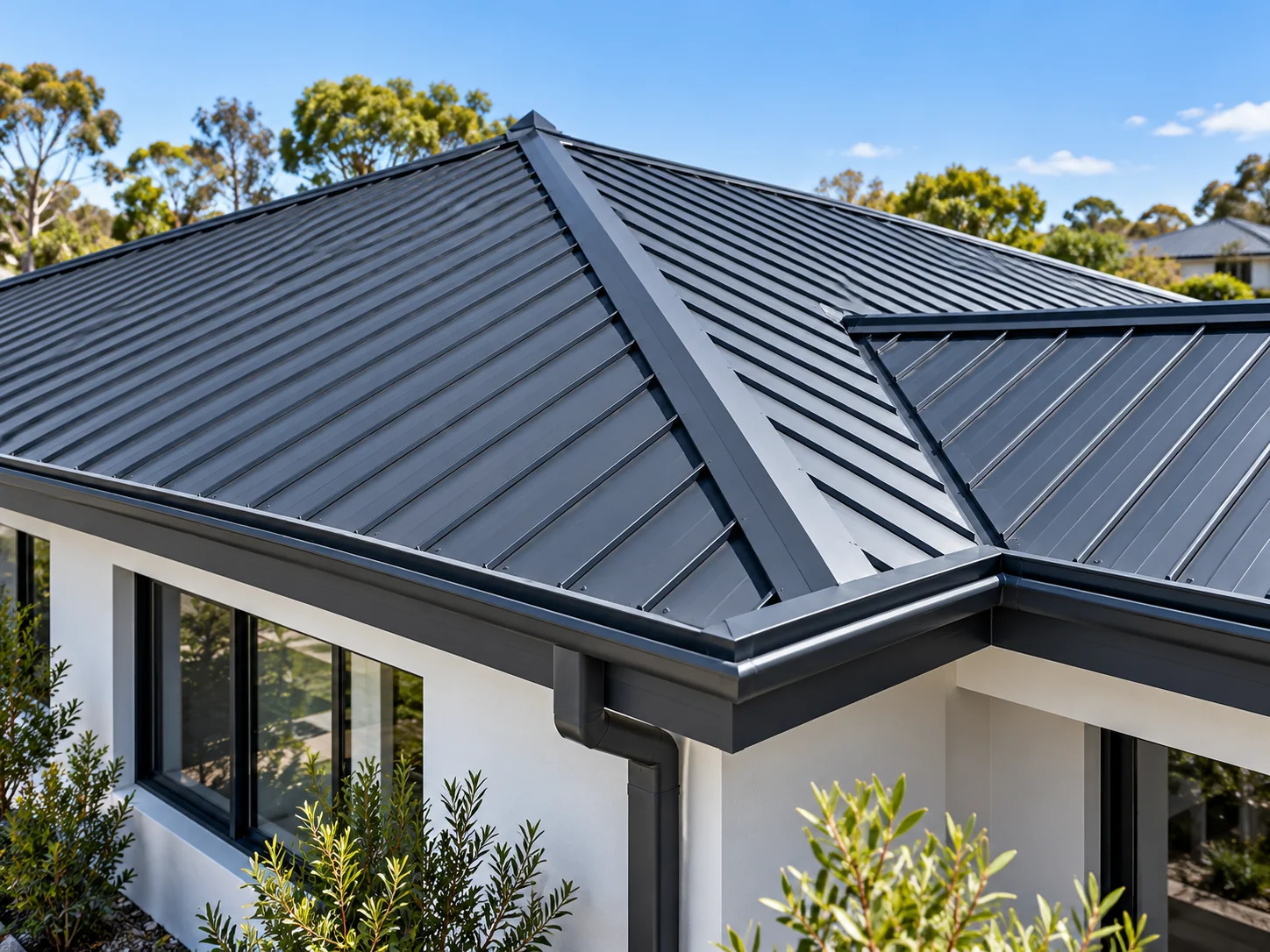
The name is a coated steel system
Colorbond is BlueScope’s pre-painted steel, coated in the mill before it is roll-formed into a roof sheet. The homeowner is buying the profile that sheds water, the colour that faces the street, the flashings that close hips, valleys and walls, and the fixings that keep the sheet on the battens in a Melbourne northerly. The invoice should describe that assembly. A colour name copied from a neighbour’s fence, or a tile roof described with a metal-sounding nickname, is a different product.
The coating is part of the steel, bonded before the sheet reaches the site. It is there to protect the base metal and to give the roof a stable colour. It is not a later film someone sprays over a tired tile field and then calls Colorbond. When Roof Revival Melbourne writes the brand on a scope, we mean the sheet system ordered for that house, cut and fixed to a frame we have walked. If the quote never names profile, colour and edge detail, the buyer does not yet know the product.
Profiles Melbourne roofs actually carry
Most suburban replacements land on a pierce-fixed corrugated profile or a concealed-fix profile. Corrugated is the familiar wave. Screws pass through the crest or the pan, depending on the specification, and the washer is what keeps the hole dry. A concealed-fix sheet clips to the batten so the fastener sits under the lap. Both are Colorbond when the steel is that product. They are not interchangeable on a quote. The clip system changes the batten layout, the way a penetration is flashed, and how a later repair is done.
Colour is a street and heat decision
The colour range is large, and the name on the chart is the colour of the paint system, not a guarantee about the room below. Lighter colours reflect more of the sun. Darker colours absorb more and the roof space runs warmer. We will talk about that when the house already struggles in January, and we will not pretend a colour change is an air conditioner. In Camberwell or Kew, the street may care more about a muted tone than about the last degree in the roof space. In a newer estate the covenant may already name an approved colour. We ask before we order.
What has to sit under the sheet
The sheet is the rain plane. The roof is also sarking, battens, and the way water leaves the edge. On a tile-to-metal change, the old battens usually come off. New battens are spaced for the profile, not for the tile lug they replaced. Sarking is specified for the condensation risk in a Melbourne winter, when night air cools the sheet and the roof space is still moist from showers and cooking. A sheet fixed to tired tile battens, with the old underlay left in ribbons, is not the assembly the brand is known for.
Valleys, aprons, barge cappings and the gutter line are where cheap quotes go quiet. A penetration for a flue, a whirlybird or a solar rail needs a flashing that belongs to the profile. We list those junctions. Gutters are in the scope when they are rusted through or sized for a tile drip edge that will no longer exist. Insulation is a conversation, not a free extra hidden in the word “Colorbond”. If the ceiling is already tight and the house needs a thermal break, we say what is included and what is a separate trade. The buyer should be able to read the roof from the quote without guessing which lines were assumed.
The buy is a replacement, unless the old roof still has life
People search “Colorbond roofing” when they want a new metal lid. That job is a replacement. On a standard Melbourne home it commonly starts around $20,000, then moves with squares, storeys, pitch, access and how much gutter, flashing and solar work is actually in the scope. The page that describes that job is Colorbond roof replacement in Melbourne. We do not turn the brand name into a per-square guess from the footpath.
A tired concrete tile roof in Glen Waverley or Box Hill is not automatically a Colorbond buy. If the tile body is still hard, the timber is dry and the failure is ridges, broken units and a worn face, the honest job is often a restoration. Planning bands for a standard home sit around $4,000–$12,000. We will say that on the roof. Selling a new steel lid to a house that needed bedding and a specified coating wastes the frame you already have. Selling a coating to a field that is crumbling wastes the coating. The inspect chooses.
What we write down before steel is ordered
We are on the roof and, where it is safe, in the roof space. We note profile and colour as a proposal, not as a guess from a real-estate photo. We note pitch, penetrations, valleys, the gutter condition, and whether the frame and fascia can take the new sheet. We note solar, skylights and any eaves or roof sheeting that looks like asbestos cement. If that material is present, the quote stops at identification. Removal belongs to a licensed removalist. We do not write a homeowner method for it, and we do not fold it into a casual “strip and go”.
Typical path from the word Colorbond to an order
- 1. Inspect the roof, the frame and the street constraints
- 2. Name profile, colour, pitch and the flashing list
- 3. Separate a sound tile restore from a real replacement
- 4. Order the specified steel once the scope is agreed
- 5. Strip, fix, flash and photograph the handover