Key takeaways
- Dark surfaces take in more solar radiation. Light surfaces reflect more of it.
- It matters more on the planes that take the western sun, on two-storey houses where the bedrooms sit in the roof, and on simple gables with a big unshaded face.
- Do not believe a precise temperature drop quoted from a brochure without the roof space attached.
General guidance for Melbourne roofs. The written scope after an assessment decides the work.
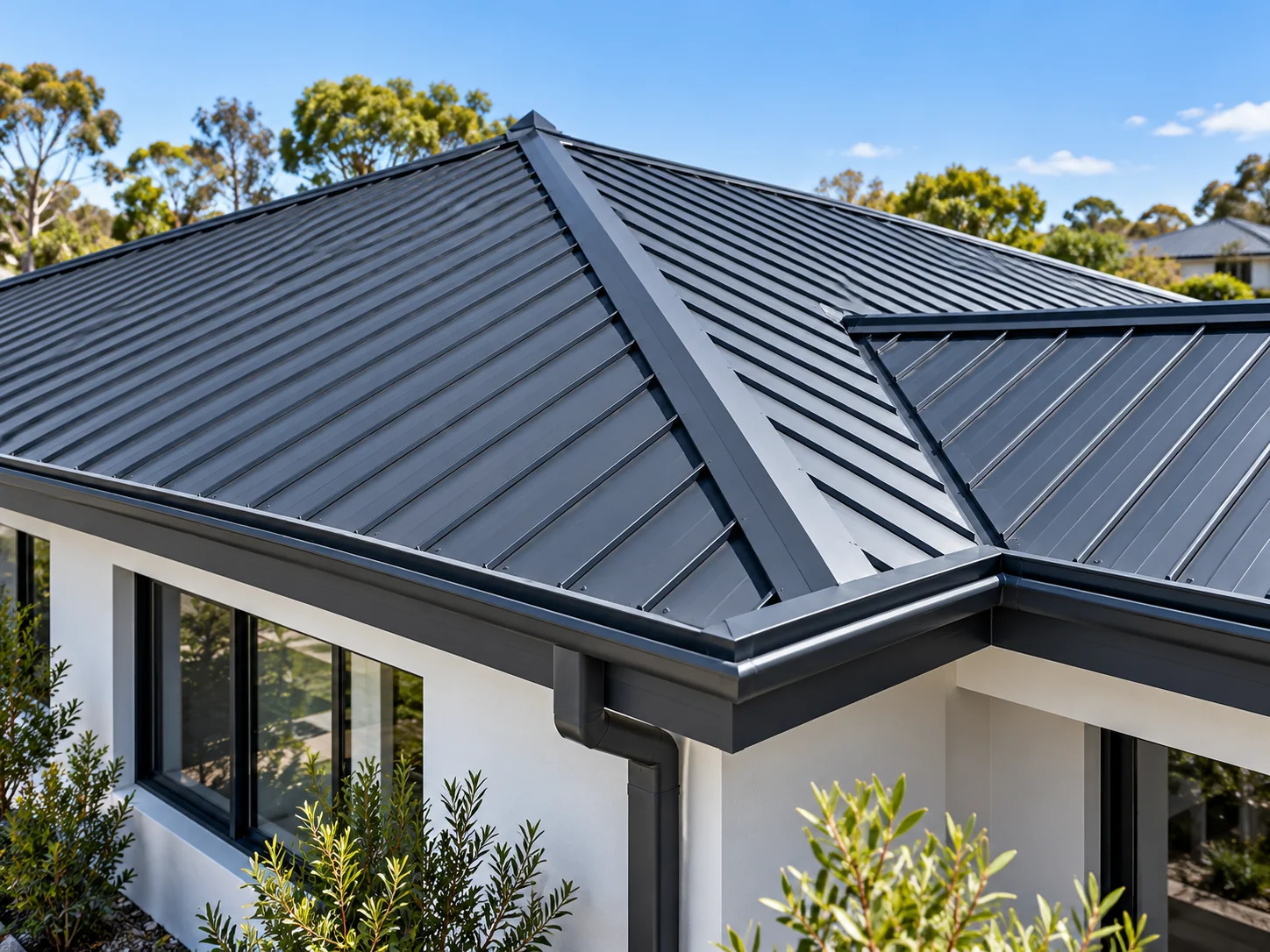
The swatch is real, and it is not the whole roof
Dark surfaces take in more solar radiation. Light surfaces reflect more of it. That is ordinary physics, and it applies to Colorbond as it applies to any painted metal left in a Melbourne January. A Monument or a similar deep colour on a west-facing plane will run hotter to the touch than a surfmist-type light on the same pitch, on the same afternoon, in the same suburb. Anyone who tells you colour makes no difference is selling a fashion choice as if it were neutral. Anyone who tells you colour is the whole difference is selling a swatch as if it were insulation.
What you feel upstairs is the heat that gets through the sheet, across the roof space, and through the ceiling. A light colour reduces what arrives at the underside of the sheet. A blanket, a ventilated space and a ceiling with some resistance decide how much of the remainder reaches the room. Leave those out, and a light roof can still sit over a hot bedroom. Include them, and a darker roof can be liveable. Roof Revival Melbourne specifies the build-up when we replace a roof. The replacement itself is Colorbond roof replacement in Melbourne. Colour is chosen inside that job, with the heat question asked out loud.
Where colour matters more in Melbourne
It matters more on the planes that take the western sun, on two-storey houses where the bedrooms sit in the roof, and on simple gables with a big unshaded face. Growth-corridor houses in Tarneit, Mickleham and Clyde often have exactly that: a wide upstairs, a dark roof chosen from a facade sheet, and a summer that arrives as a hot north-westerly. The roof was legal and popular. The west rooms are still the ones people complain about at 5pm. If you are replacing that roof, or replacing the tiles that are about to become that roof, the west plane is the one to talk about before the order.
It matters less, though not never, on a single-storey house under mature trees in the inner east, where the roof is shaded for half the day and the ceiling is closer to a normal room than to an attic. It matters differently again near the bay, where the sun is strong but the evening breeze is part of how the house cools, if the windows and the eaves let it. We will not give you a suburb-wide rule. We will ask which rooms overheat now, and whether that is the roof colour, the glass, or a roof space that has never been ventilated.
Winter is the honest counterweight. Melbourne is not only a cooling climate. A darker roof picks up useful warmth on clear July days, and a very light roof reflects some of that away. For most houses the summer complaint is the one owners raise, because February is when the upstairs becomes the issue. If you want the dark street face, have the summer conversation anyway, and put the answer in insulation and ventilation rather than in hoping the colour will behave.
What not to believe about a colour name
Do not believe a precise temperature drop quoted from a brochure without the roof space attached. “Several degrees cooler” can be true of the sheet surface and weak in the room, or the other way around once the blanket is in. We will not invent a number of degrees for your bedroom. We will say the direction: lighter absorbs less, darker absorbs more, and the ceiling build-up is where the design either respects that or ignores it. Solar absorptance is the idea behind the swatch. You do not need the laboratory table to make a sensible choice. You need to know your west rooms and your insulation.
Do not believe that a gloss or a fashionable name changes the physics. Some light colours still absorb more than they look as if they should, and some mid tones are a compromise that keeps the street from looking stark. Ask for the relative absorptance if you are choosing between two close colours, and then weigh fade, glare into a neighbour’s windows, and any overlay that limits pale or dark roofs. Glare is a real neighbour issue on a steep light plane facing a living room across a narrow block. Heat is not the only courtesy the colour owes the street.
Do not believe you can paint your way to a cool house as a weekend project. If an existing dark Colorbond roof is sound, a proper recoating to a lighter colour can be discussed as a coating job with preparation, not as a tin of roof paint. We do not describe that method for you to attempt. If the sheet is tired, holed, or due for replacement anyway, a new colour on a new roof is the clean decision. Replacement commonly starts from about $20,000. A coating on sound steel is a different and smaller product, and it still will not install the insulation you never had.
Insulation and ventilation do the work the swatch cannot
When tiles come off or old sheet comes off, you can see the roof space properly. That is the moment to stop heat, not six months later when the rooms are already complained about. Sarking or a blanket specified for the roof, a path for air to move rather than a sealed oven, and a ceiling that is not full of unsealed downlight holes, are the practical list. Whirlybirds and eaves vents are details, not magic. They help if there is an inlet and an outlet. They do little if the space is choked or if the heat is mostly pouring through bare plaster under a dark sheet.
West-facing glazing can outvote the roof. A dark Colorbond plane is an easy thing to blame because you can see it from the park. A two-metre sliding door with no external shade will heat the same room on a January afternoon even under a pale roof. If the inspection is about comfort, say which room and which time of day. We will not pretend a colour change fixes glass. We will also not ignore the roof when the roof is genuinely the hot lid on an upstairs bedroom.
Choosing with the replacement, not after it
Colour should be named in the same quote as the profile, because both are ordered together, and because an overlay may accept the material and refuse the colour. Pale roofs and near-black roofs both get queried in some streets. Have that answer before the steel is cut. Fade belongs in the same conversation: deeper colours show chalk and uneven weathering more obviously on the north and west, which in Melbourne is a long-term appearance issue as well as a heat issue. A light roof can look stained by gutter overflow and tree litter. Neither is morally superior. Both should be chosen with the maintenance you are willing to see from the footpath.
If you are not replacing, do not let a heat complaint talk you into stripping a sound roof. Fix ventilation and insulation if they are the gap. Recoat only when the sheet qualifies. Replace when the sheet or the tiles are finished and the new colour is part of a complete roof, not a sticker on an old problem. Send the suburb, which rooms overheat, and a photo of the roof in afternoon light if you have one. We will say whether colour is the lever, or whether the lever is the space under it.
How we talk about colour
- 1. Ask which rooms overheat, and when
- 2. Separate sheet colour from insulation and ventilation
- 3. Prefer a lighter absorptance on hard western planes
- 4. Check overlay, glare and fade before the order
- 5. Name the colour in the replacement scope, not after handover