Key takeaways
- Carlton terraces look, from the footpath, like a long slate or terracotta lid between two brick walls.
- The party wall is the Carlton leak owners argue about, because the stain ignores the title boundary.
- Many Carlton street faces are a parapet. The coping and the flashing that turns water into the box gutter are out of sight from the footpath and very much in the weather.
General guidance for Melbourne roofs. The written scope after an assessment decides the work.
The short version
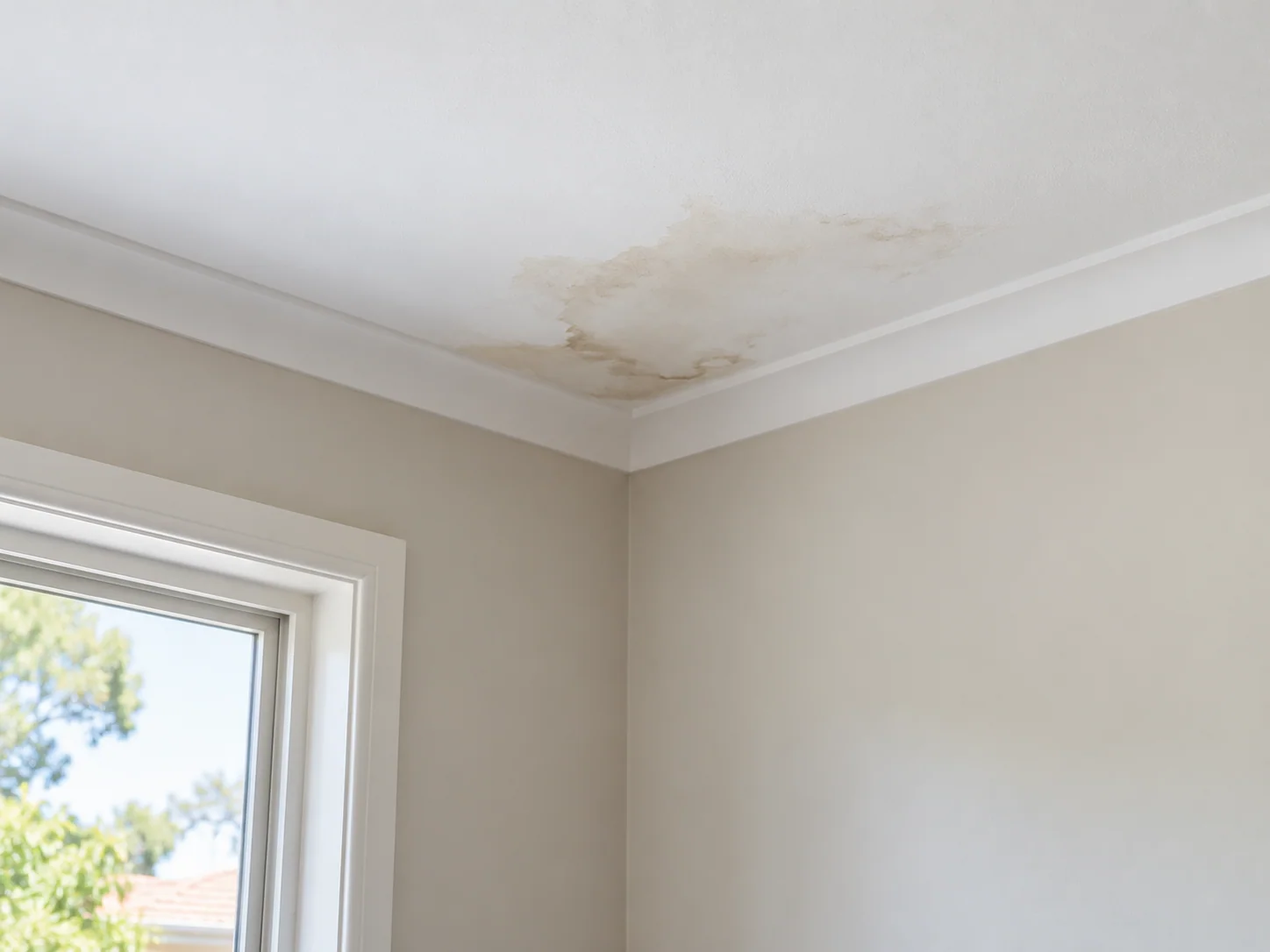
Carlton terraces look, from the footpath, like a long slate or terracotta lid between two brick walls. The lid is often still doing its job. The openings are at the edges: where your roof meets the neighbour, where a parapet hides a gutter, where a chimney punches through, and where a rear addition cuts a valley into the original pitch. Rain gets in there, travels, and stains a ceiling that can be a room away. Leak repairs for that path are roof leak repairs in Melbourne.
A quote that starts with “the roof is old, replace it” has skipped the map. A quote that starts with “coat it” has skipped it too. The map is short. Name the joint. Show the trip to the stain. Replace the metal or the bedding that failed, and the units that had to come off to reach it, with a match. If the field itself has finished, say that with photos. Do not infer it from the age of the brick.
Party walls
The party wall is the Carlton leak owners argue about, because the stain ignores the title boundary. Soakers and cover flashings dress the joint between your roof and the shared wall, or between two roofs. Bricks get repointed from the street. The metal above the roof line does not. It lifts, it cracks, a previous silicone bead lets go. Water runs the wall and appears in a bedroom, sometimes yours, sometimes the neighbour’s, sometimes both. The opening can be entirely on one roof.
The repair is that flashing, dressed back under the slates or tiles, plus any units slipped when the joint was last walked. The quote says which roof is being opened. If we need the neighbour’s side to see the cover, that is an access note, agreed before the day. Guessing, and replacing a field of sound slates because the stain is near the wall, spends the money beside the hole. Roof Revival Melbourne would rather point at the soaker. You should be able to see it in the photos without trusting a storey about “old terraces”.
Parapets and the box gutter behind them
Many Carlton street faces are a parapet. The coping and the flashing that turns water into the box gutter are out of sight from the footpath and very much in the weather. Copings crack. Flashings pull. The gutter, often original iron, fills with leaf from the street trees and rusts through. Overflow returns under the first courses. The front room stains along the street wall, and everyone looks at the chimney because the chimney is what they can see.
Two different conditions live in that gutter. Litter that makes a sound gutter overflow is maintenance: the water never needed a hole in the roof. A split sole or a gutter with no fall is a repair of that length, plus the edge it has been wetting. We write which one the inspect found. Both can be true. A scoop of leaves does not close a hole, and a new gutter does not fix a coping that still sheds the wrong way. The front room dries when the path is closed, not when the tiles in the middle of the roof are painted.
Chimneys and valleys
Carlton stacks are brick and they move. The saddle, the metal apron around the stack, opens. Silicone looks tidy for a season and then cracks. Water runs the brick into the ceiling on the chimney breast. That stain sits under the chimney, which makes it the honest one: the entry and the mark agree. The repair is metal and dressing, tiles or slates reset, and a note if the cap itself is letting water into the chase. It is still one detail unless the ridges on either side have failed as well.
Valleys are the dishonest stain. A rear skillion, a lightwell, or an L-shaped plan creates a tray between two faces. When the iron rusts or clogs, water leaves the tray and runs under the covering. It can drip in a hallway that does not feel related to the back addition. Following the stain straight up finds clean slates. Following the water from the valley finds the hole. We lift what we need, replace the failed length, and reset the units. Pointing over a rusty tray leaves the path where it was. The how to find a roof leak page is the general method. On a Carlton terrace the method starts at the four joints above, because that is where these houses actually open.
What the middle of the roof is doing
Slate and terracotta in the field fail too, just not first as often as people fear. A few slipped or cracked units around the joint are part of the repair allowance. A field that delaminates, snaps, or has lost its fastenings across both faces is no longer a leak detail. That is when we talk about the covering itself. Replacement commonly starts from about $20,000, and on these terraces the material and the access are part of why. A restore, when the units are sound and the ridges have opened along the run, plans around $4,000–$12,000 for a standard home. Carlton lanes and street faces move the method. They do not pick the product. The product follows the photos of the units and the sarking.
Heritage overlays sit on a lot of this stock. A leak repair that puts the same slate or tile back is the usual work. A change to metal on the street face is not a leak repair and should not be offered as one. Say if an overlay is already on your paperwork. We still trace the water. We do not use the overlay as a reason to leave a saddle open, and we do not use the leak as a reason to change the row.
Solar and roof windows add punctures that can mimic a terrace leak. A cracked flashing at a skylight is a skylight detail. Water from it still travels. We check the original joints and the later punctures, and we name which one is wet. An owner who has both a parapet gutter and a skylight does not need both replaced on a hunch. One of them is usually the path.
What you should see before you pay
A photo of the opening. A sentence that connects it to your stain. The metal or mortar being renewed. The units coming off and going back, matched. Access: lane, scaffold, or through the house. Whose wall. What is sound and staying. If someone recommends a new roof, a photo of failed units or failed sarking, not a paragraph about Carlton being old. Roof Revival Melbourne will put that pack together after the inspect. Send the stain, the front parapet if you have one, and a note that it is a terrace. Stay off the roof. The entry points are not safe viewing spots, and they are exactly where we need to be.
Typical inspect-to-scope process
- 1. Treat the stain as the end of a path
- 2. Check party wall, parapet gutter, chimney and valleys
- 3. Photograph the opening that feeds the stain
- 4. Repair that joint with matching units
- 5. Say restore or replace only if the field itself has earned it