

Key takeaways
- Concrete tile is the volume roof through Cranbourne’s estate decades, and it is not the whole scope.
- From the 1990s through the 2000s, Casey’s growth roofs were mostly concrete tile on repeated hip and gable plans.
- Valleys collect the leaf these estates still grow, even when the nature strip looks new.
General guidance for Melbourne roofs. The written scope after an assessment decides the work.
The short version
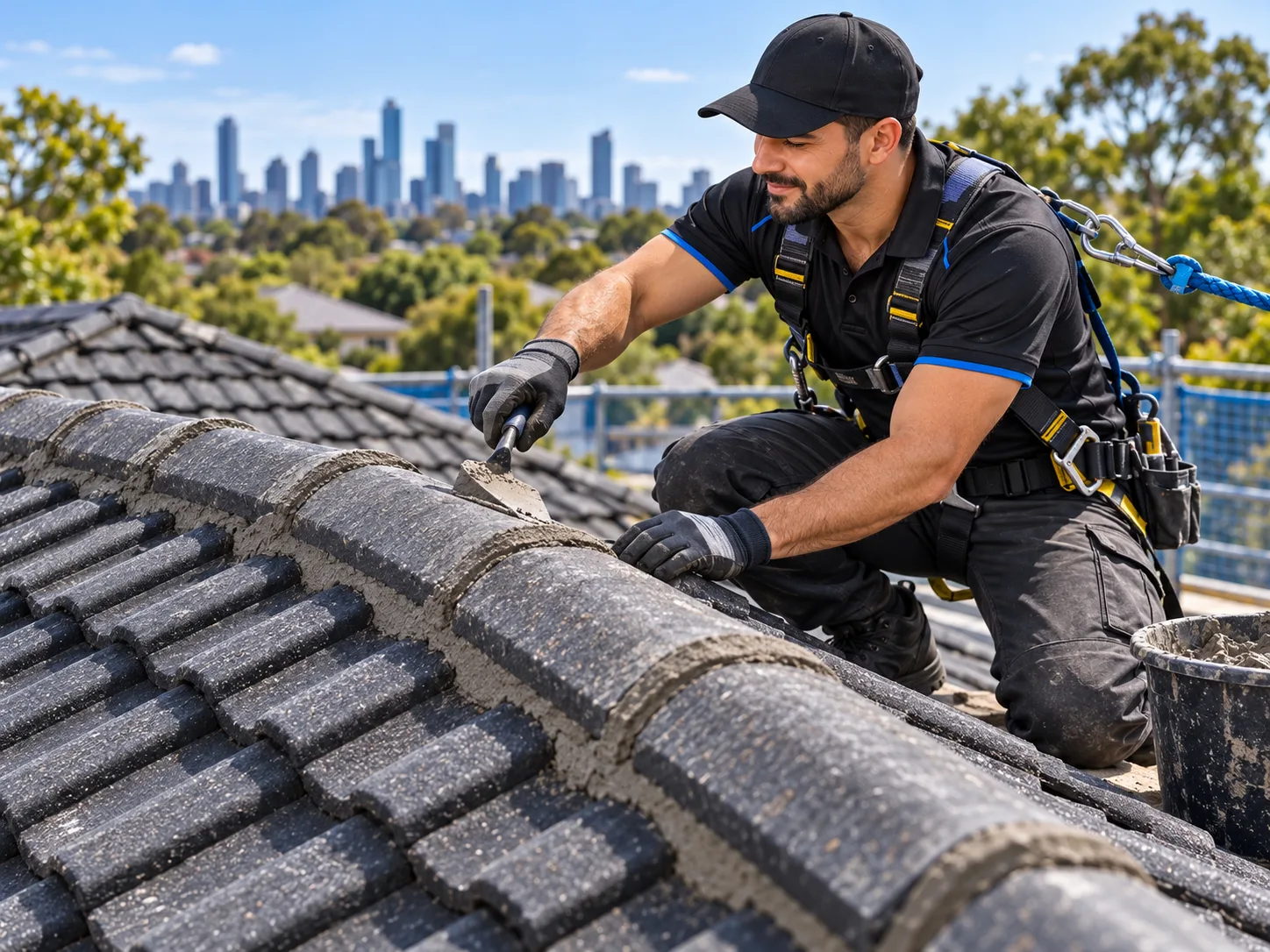
Concrete tile is the volume roof through Cranbourne’s estate decades, and it is not the whole scope. The first cycle on those hips is powder pointing, a handful of cracked units, moss on the shaded pitch, and valleys full of leaf. Some houses have a later metal wing. Some newer stages were built in a different tile, or in Colorbond, and should not inherit a 1990s restore recipe. Roof Revival Melbourne separates those lids before anyone talks coating.
The Cranbourne job sits on roof restoration Cranbourne. The inspect still says which Cranbourne you mean: the earlier courts, Cranbourne East, North, or West. A standard home restore often plans around $4,000–$12,000. That is not a Cranbourne special. It is a band that tells you a coat-only price is a different product.
Concrete tile, and why it is the default
From the 1990s through the 2000s, Casey’s growth roofs were mostly concrete tile on repeated hip and gable plans. The units are often still dense. The original mortar is often not. That pairing is why restore, not replace, is the hypothesis we drive in with — and why we still test the hypothesis on the roof. Thermal cycling cooks a bed by day and winter rain opens it. Powder in the gutter is the usual first clue. The field can look only tired from the footpath while the ridge is the leak.
A handful of cracked tiles along a tree line or where a solar crew walked is an allowance inside the restore. Twelve cracked units are not a new roof. A plane that crumbles when it is lifted is a new roof. We say which one, with a count, not a vibe. South-east storm cells bruise tiles that were sound at handover. Hail notes belong in the inspect if the owner remembers a season of dents, because a coat does not replace a fractured unit.
Colour is the last decision. Charcoal, terracotta-look, and slate-grey concrete all need the same mechanical work if the bed has failed. Painting a fresh face over powder pointing is how Cranbourne roofs “get done” and leak again before the next repaint of the eaves. Re-bed and repoint first. Prep second. Coat third. The order is the product.
What else is on the same roof
Valleys collect the leaf these estates still grow, even when the nature strip looks new. A rusty valley is a line. A blocked valley over dry sarking is often a clean plus a repair, not a strip. Whirlybirds and pipe penetrations that were never resealed become winter drips that owners blame on “the tiles”. The tiles may be fine. The boot may not. Each penetration is its own sentence in the scope.
Second storeys and later extensions add junctions the original display-home plan did not have. A valley that dumps onto an older plane, an apron at a parapet, a box gutter over an ensuite — those are where Cranbourne leaks start while the main field still looks ordinary. We assess original and addition together. Matching a 1998 concrete to a 2012 concrete is a product note. Flashing the step is a water note. Do not buy a coat on the front plane and leave the pop-up as a surprise.
Gutters that were never reset sit low and overflow into fascia. That is not cured by a roof coating. If the trough is holed, it is a replacement line. If it is only full of granule and leaf, say so. We will tell you when the spend is maintenance rather than restoration. Sarking is the quiet extra: if it is dry, the restore protects it. If it is wet across bays, the conversation moves towards replacement, and no membrane on the tile changes that.
Newer estates are a different lid
Cranbourne East and the later stages are not automatically “due for restoration” because the older courts are. A roof that is ten or fifteen years old may need a local repair — a ridge that was poorly bedded, a flashing a builder left short — not a full restore. Selling a full coat to a young, sound roof is how the trade wastes someone’s money. We look at age as a clue and the tile as the evidence.
Some of those newer roofs are metal. Colorbond on a recent build is a fastener and flashing inspect, not a concrete-tile restore. If the sheet is sound, do not invent a tile scope because the neighbour’s 1990s hip is being coated this month. If the sheet has failed at laps or the underlay is wet, that is replacement language, and it is a different quote. One street can hold both jobs. The paperwork has to say which house is which.
Access on estate streets is its own problem. Narrow courts, small front setbacks, and two-storey houses on tight blocks change where a scaffold stands and where a skip can sit. We put that in the quote. A price copied from a wide 1990s block onto a tight newer court will either blow out or skip the high work. Neither is acceptable.
What the quote should list
Inspect result, ridge and hip metres, broken-tile allowance, valleys and penetrations, prep, and a named coating if the body is sound. Flashings and gutters only if they need work. Solar off and on if panels cover bays we must reach. Storeys. The words “concrete tile restore” without those lines are a label. You should be able to compare two Cranbourne quotes by the lines, not by the suburb name in the heading.
The Melbourne band of about $4,000–$12,000 helps you see a spray that cannot include beds and swaps. Large two-storey hips sit higher. A single ridge repair can sit lower and still be the right spend. Replacement, when the field is finished, commonly starts around $20,000 and is a different product. We do not publish a Cranbourne price. We quote after we are on that roof. Read concrete tile restoration for the eastern method this stock shares, and re-bed versus repoint so the ridge line means something.
Before you book
Say concrete, terracotta, or metal. Say one storey or two. Say whether there is a leak stain or only a tired colour. Two photos from the ground are enough to book; they are not enough to price. We still walk it. If a building report says “replace” because the inspector saw moss, bring the PDF and let us test the tile. Moss is growth. A soft unit is failure. Cranbourne has plenty of both, and they are not the same invoice.
Roof Revival Melbourne will restore a sound concrete hip and will say so when the “what else” has become the whole roof. The coating is the face. The ridges, the valleys, and the dry roof space are the job.
Cranbourne inspect, in order
- 1. Confirm concrete tile, metal, or a mix
- 2. Test the body and the ridge bed
- 3. List valleys, penetrations, extensions, and gutters
- 4. Check sarking where we can
- 5. Quote the restore, or say replace